
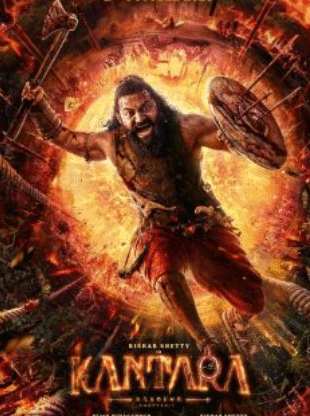
Kantara: A Legend – Chapter 1 is a visually stunning prequel that explores the folklore, ambition and conflict between nature and power behind Karnataka’s Bhuta Kola tradition. It earned about ₹850 crore worldwide, and our verdict is a strong recommendation for its spectacle, its final act and Rishab Shetty’s performance, with the caveat that it lacks some of the spiritual intensity of the 2022 original.
The film is directed by Rishab Shetty, who also stars, and was released on 2 October 2025, the Dussehra holiday. This review covers the story, the performances, the craft, the box office, critical reaction, our own review with a rating, pros and cons, and where to watch.
Note on the title: the film’s official name is Kantara: A Legend – Chapter 1. Chapter 1 is a prequel to the 2022 film Kantara, not a sequel.
At a glance
| Detail | Information |
|---|---|
| Release date | 2 October 2025 |
| Original language | Kannada, with Hindi, Tamil, Telugu and Malayalam dubs |
| Director | Rishab Shetty |
| Writers | Rishab Shetty with Anirudh Mahesh and Shanil Goutham |
| Producers | Vijay Kiragandur and Chaluve Gowda, Hombale Films |
| Lead cast | Rishab Shetty, Rukmini Vasanth, Jayaram, Gulshan Devaiah |
| Music | B. Ajaneesh Loknath |
| Cinematography | Arvind S Kashyap |
| Editing | Suresh Mallaiah |
| Runtime | 169 minutes |
| Worldwide gross | about ₹850 crore (reported) |
| Budget | Not officially confirmed |
| Streaming | Amazon Prime Video |
Plot and highlights (spoiler-light)
The film is set in pre-colonial coastal Karnataka, centuries before the 2022 film, during the Kadamba dynasty. It traces the mythical origins of the sacred traditions and divine guardians, the Daivas, that the original Kantara only hinted at, including the origins of the Panjurli and Guliga Daivas.
The hero is Berme, a warrior raised by the tribe of the sacred forest, who is pitted against a ruler who wants to exploit that forest and its resources. Power, deceit and resistance drive the story, with betrayals inside and outside the tribe, and Berme guided by the divine spirits he serves.
What stands out
- The possession scenes. The Bhuta Kola trance sequences, in which Berme channels the Daivas such as Guliga, are the emotional and visual peak and the reason many viewers call the finale unforgettable.
- World-building. Ports, trade, courts and forest settlements are drawn on a much larger canvas than the 2022 film.
- Scale of the action. Large battle set pieces replace the village-scale conflict of the original.
- A bridge to the first film. It sets up the tradition and the ancestral conflict that the original film’s audience already knows, and it points towards a further chapter.
Note on the original draft: details such as Berme being found at a sacred well, the “Bangara” kingdom, a “spice garden” and “genderless divinity” could not be confirmed in the sources we checked, so we describe the story in the terms those sources use.
Cast and performances
| Actor | Role | What to know |
|---|---|---|
| Rishab Shetty | Berme (also Mayakara, plus archive-footage roles) | Lead, director and co-writer; the climax and trance scenes are his strongest work |
| Rukmini Vasanth | Princess Kanakavathi | Less screen time in the first half, a stronger presence in the second; won Best Actress at the Iconic Gold Awards |
| Jayaram | King Rajashekara | A seasoned performance that anchors the court scenes |
| Gulshan Devaiah | King Kulashekara | A convincing villain whom viewers end up disliking |
| Pramod Shetty | Bhogendra, a minister | Supporting role in the court |
| Naveen D. Padil | Booba, a port official | Comic and trade-port flavour |
Rishab Shetty dominates the film as star and director, and critics singled out him and Rukmini Vasanth for praise. A Free Press Journal review specifically credited Jayaram for anchoring the film and Gulshan Devaiah for making the villain believable. Reviewers also felt the film’s humour, mostly from the supporting cast, sometimes broke the tension.
Direction, visuals, music and craft
Direction. Rishab Shetty directs on a far larger scale than in 2022, trading a village-level conflict for kingdoms, ports and war. The ambition is the film’s strength and also the source of its problems, since critics found the narrative uneven and crowded for one viewing.
Cinematography. Arvind S Kashyap’s camerawork was described as outstanding. The forest, the festival and the possession sequences are where it shows most.
Music and score. B. Ajaneesh Loknath’s background score was praised for pulling viewers into the world, while the songs were considered weaker overall, with “Varaha Roopam” the exception.
Editing. Suresh Mallaiah’s editing was called commendable, though one reviewer wanted the jail scene and the scenes before the tiger face-off trimmed for crispness.
VFX, sets and costumes. The visual effects were rated top class by the Free Press Journal, and critics highlighted the set design and costumes as authentic and grand.
Pacing. The first half drags and the film only reaches full momentum in the second half, where the climax delivers on the build-up.
How the film was made
The production was one of the largest in Kannada cinema, and its scale shows on screen.
| When | What happened |
|---|---|
| February 2023 | Rishab Shetty confirmed a prequel to Kantara (2022); scripting took about eight months with Shanil Goutham and Anirudh Mahesh |
| November 2023 | Principal photography began with a formal pooja ceremony |
| April 2024 | A major portion was shot in Keradi, Kundapura, Shetty’s village, where more than 600 carpenters built a large set |
| January 2025 | Filming moved to the Sakleshpur forests; the makers were fined ₹50,000 for dumping material in a protected forest area |
| February 2025 | A war sequence was shot on a 25-acre set; it took nearly 50 days, with more than 500 skilled fighters and a total cast of nearly 3,000 people |
| May 2025 | The final schedule was shot about 20 km from Kundapur |
| July 2025 | Filming wrapped after roughly 20 months |
Preparation. Shetty learned horse riding, Kalaripayattu and sword fighting for the role, and reportedly filmed the climax with his legs swollen and bruised.
Setbacks. In November 2024 a bus carrying crew members had an accident near Jadkal and shooting paused. In May 2025 a report claimed that actor Rakesh Poojary had died on set, and the makers clarified that he died at a family function, not on the film set.
Release formats. It opened on 2 October 2025, including in IMAX, D-Box, 4DX and Dolby Cinema formats, and a shorter English and Spanish version followed on 31 October 2025.
Music release. Composer B. Ajaneesh Loknath’s singles “Brahmakalasha” (28 September 2025) and “Rebel Song” (1 October 2025) came before the full album on 11 October 2025. Diljit Dosanjh sang the Hindi version of “Rebel Song”.
Box office and records
The film grossed about ₹850 crore worldwide (reported as ₹850 to ₹852 crore depending on the source). Its opening day brought roughly ₹60 to ₹64 crore net in India, with about ₹19.5 crore of that from the Hindi version.
Records reported
- Second-highest-grossing Kannada film of all time
- Reported as the highest-grossing Indian film of 2025, though sources conflict on whether it ranks first or second for the year
- First film to gross over ₹250 crore in Karnataka
- Sixth Hindi-dubbed film to gross ₹200 crore in India
- Fourth Indian film to gross over ₹50 crore each in Karnataka, Tamil Nadu, Andhra Pradesh/Telangana and Kerala
The budget has not been officially confirmed. Trade reports only said it was significantly higher than the original’s.
Sources: Wikipedia, Hollywood Reporter India, Sakshi Post.
Audience and critical reaction
Reception was positive but not unanimous. Rotten Tomatoes lists 82% positive reviews from 11 critics (average 6.5/10). Rishab Shetty’s performance drew near-universal praise, while opinions on the film as a whole varied.
| Outlet | Rating |
|---|---|
| India Today | 4 / 5 |
| Bollywood Hungama | 4 / 5 |
| News18 | 3.5 / 5 |
| Filmfare | 3.5 / 5 |
| Rediff | 3.5 / 5 |
| Free Press Journal | 3.5 / 5 |
| NDTV | 3 / 5 |
| The Indian Express | 3 / 5 |
| Hindustan Times | 3 / 5 |
| Deccan Herald | 2 / 5 |
What critics praised: the visual spectacle, the second half and climax, the lead performances, the set design and the background score.
What critics criticised: an uneven narrative that tries to do too much, less emotional soul than the 2022 film (The Indian Express wrote that the soul “flickers in and out unsteadily”), a dragging first half, forced humour, and a story that stays largely male-oriented.
Compared with the original. Some longtime fans felt that the war-focused story has less of the spiritual depth and emotional intensity of Kantara (2022). Others valued the larger canvas and the new legend it builds.
Awards. Rukmini Vasanth won Best Actress (Pan India Movie) at the Iconic Gold Awards, and at the Indian National Cine Academy Awards the film won Best Film (Kannada), Best Director and Best Actor for Rishab Shetty, and Best Actress for Rukmini Vasanth.
Chapter 1 vs the original Kantara (2022)
| Kantara (2022) | Kantara: A Legend – Chapter 1 (2025) | |
|---|---|---|
| Era | A much later era than Chapter 1 | Pre-colonial coastal Karnataka, the Kadamba period |
| Scale | Village-level conflict | Kingdoms, ports, courts and large battles |
| Focus | Faith, land and the Bhuta Kola ritual | The origins of the Daivas and the legend behind the tradition |
| Director | Rishab Shetty | Rishab Shetty |
| Producer | Hombale Films | Hombale Films |
| Common critical view | Tighter and more emotional | Bigger and more spectacular, with a more uneven story |
The general view among reviewers is that the original is the more focused and emotionally direct film, while Chapter 1 is the grander one. Both build to a possession climax, and many viewers rate that finale as the best part of each.
Note: the comparison on tone is based on how critics described the two films, and we have not included the 2022 film’s box office figures because we did not verify them for this article.
Our review
Kantara: A Legend – Chapter 1 is a film of big ideas and bigger images. Its best moments, the trance sequences and the final stretch, justify the trip to a theatre on their own, and they show what Rishab Shetty can do when he combines performance, ritual and cinema.
The story and world. Going back centuries gives the film room to build a legend rather than repeat one. The idea that the forest and its guardians are what a ruler cannot own has real weight, and it links neatly to the environmental and tribal-identity themes that made the original resonate. The story is at its most gripping when it stays close to Berme and the Daivas, and at its weakest when it moves into palace politics, where the writing feels crowded and some plot turns are predictable.
Performances. Rishab Shetty carries the film. His Berme is earnest and physical, and the possession scenes, when Berme channels the Daivas, are the work of an actor and director who understand the ritual they are staging. Rukmini Vasanth gains ground in the second half, Jayaram gives the court a solid centre, and Gulshan Devaiah makes a villain you want to see lose.
Craft. The cinematography, set design, costumes and background score are first-rate, and the effects are mostly convincing. The songs are the weak link, and the first half is longer than it needs to be. The humour around the supporting characters sometimes undercuts the tension.
Compared with the original. The 2022 film worked because it was small, specific and emotional, and it ended with a climax that felt like a revelation. Chapter 1 trades some of that intimacy for scale. It does not match the original’s spiritual punch, but its final act comes close to it.
Our verdict. Be patient with the first half and the film pays you back. It is a strong, flawed epic that raises the bar for Kannada and Indian spectacle cinema.
Our rating: 4 / 5
Overall we rate it 4 out of 5, with its visuals and climax scoring highest and its first half and songs holding it back.
| Category | Score (out of 5) | Note |
|---|---|---|
| Story and world-building | 3.5 | Ambitious legend, crowded in the palace scenes |
| Performances | 4.5 | Rishab Shetty’s best work is in the trance scenes |
| Direction | 4 | Large-scale, confident, occasionally overstuffed |
| Cinematography and VFX | 4.5 | Outstanding visuals |
| Music and score | 3.5 | Strong score, weaker songs |
| Pacing and editing | 3 | Slow first half, powerful finale |
| Rewatch value | 4 | The finale and ritual scenes reward a second viewing |
| Overall | 4 | A strong, flawed epic |
These are our editorial ratings, informed by critic and audience reception.
Pros and cons
Pros
- Rishab Shetty’s commanding performance and the possession scenes
- Outstanding cinematography, set design and costumes
- Strong background score and top-class VFX
- A powerful second half and finale
- A larger world that deepens the Kantara mythology
- Good supporting turns from Rukmini Vasanth, Jayaram and Gulshan Devaiah
Cons
- A slow, dragging first half
- Uneven, crowded narrative
- Less spiritual depth and emotion than the original
- Forced humour in places
- Songs are weaker than the score
- Story stays largely male-oriented
Why this film matters
The film matters because it shows how far a regional, folklore-rooted story can travel. A Kannada film built on a local ritual tradition reached about ₹850 crore worldwide, became the second-highest-grossing Kannada film of all time and was the first to cross ₹250 crore in Karnataka alone.
- Regional stories, national audiences. It was dubbed into Hindi, Tamil, Telugu and Malayalam, and the Hindi version alone earned over ₹200 crore in India.
- Folklore as blockbuster material. It treats the Bhuta Kola and Daiva traditions as living culture rather than as a backdrop, and builds big-screen spectacle around them.
- Themes that last. The conflict between a ruler’s greed and a community’s relationship with nature, and questions of tribal identity, give the action an idea to hold on to.
- A growing universe. It connects pre-colonial myth to the world of the 2022 film and points towards a further chapter.
Themes explained
Nature versus power. The central conflict is between a ruler who wants to exploit a sacred forest and a community that treats it as home and as something divine. It is the idea that makes the story more than a battle film.
Faith as living tradition. The Bhuta Kola and the Daivas are shown as practised belief, not decoration. The possession scenes are where the film asks the audience to feel that belief rather than just watch it.
Tribal identity and belonging. Berme is raised by the forest community and caught between that identity and the world of the court. The film uses that tension to explore who gets to decide what is sacred.
Betrayal and resistance. Threats come from inside as well as outside the tribe, so the story keeps asking who can be trusted.
Legend-making. The film is openly about how a legend is born, and it links the origin of the Daivas to the story the 2022 film told. Not every viewer will agree with the choices it makes, which is part of the fun of discussing it.
Who should watch it, and where to stream
Watch it if you love Indian folklore, epic action and big-screen spectacle, enjoyed the 2022 Kantara, or want to see Rishab Shetty at his most ambitious.
Think twice if you want a tight, quiet drama, dislike slow openings or expect the same emotional intensity as the original.
Do you need to see the original first? It is a prequel, so it works on its own, but the 2022 film adds context and makes the connections more rewarding.
Where to watch. The film streams on Amazon Prime Video. It arrived on 31 October 2025 in Kannada and dubbed Tamil, Telugu and Malayalam, and the Hindi version followed on 27 November 2025. Availability varies by country, so check the app for your region.
Final verdict
A must-watch for fans of Indian folklore, epic action and cinematic grandeur. Kantara: A Legend – Chapter 1 is flawed, fearless and visually spectacular, and Rishab Shetty proves once again why the world of Kantara stands out in modern Indian storytelling. Our rating: 4 / 5.
Did Chapter 1 live up to the original for you? Tell us in the comments.
FAQs
Is Kantara: Chapter 1 a sequel or a prequel? A prequel. It is set centuries before the 2022 film and explains the origins of the traditions and Daivas that film showed.
Who directed it? Rishab Shetty directed it and also plays the lead, Berme. He co-wrote the script with Anirudh Mahesh and Shanil Goutham.
When was it released? On 2 October 2025, in Kannada with Hindi, Tamil, Telugu and Malayalam dubs.
How much did it earn? About ₹850 crore worldwide, according to reported figures, making it the second-highest-grossing Kannada film of all time.
Do I need to watch the first Kantara? Not strictly, but the 2022 film makes the references and the finale richer.
Is it better than the original? Most reviewers say it is bigger but less emotionally intense. Many call the original the more focused film and this one the more spectacular.
Who is the music composer? B. Ajaneesh Loknath composed the songs and the background score.
Where can I watch it online? On Amazon Prime Video. The Hindi dub arrived on 27 November 2025, a few weeks after the other languages.
Is there a Chapter 2? The film sets up a further chapter, according to reports, but check official announcements for details.
Is this a personal review? The ratings are our editorial assessment, informed by critic and audience reception.
Oh my goodness! a tremendous article dude. Thank you However I’m experiencing subject with ur rss . Don’t know why Unable to subscribe to it. Is there anybody getting similar rss problem? Anyone who is aware of kindly respond. Thnkx