
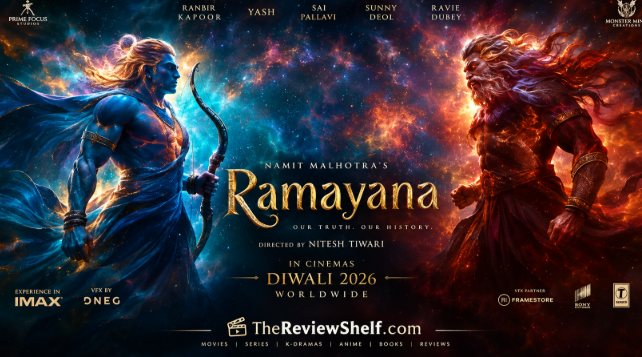
Ramayana: Part One is director Nitesh Tiwari’s two-part retelling of Valmiki’s epic, starring Ranbir Kapoor as Rama, Sai Pallavi as Sita and Yash as Ravana. It reached cinemas on November 5, 2026, just before Diwali, and opened to a huge audience and mixed-to-positive reviews. We rate it 3.5 out of 5: visually spectacular, with a standout Ravana, but short on emotional depth.
Quick Facts
| Detail | Info |
|---|---|
| Title | Ramayana: Part One (also billed as Ramayana: Rise of a Legend) |
| Release date | November 5, 2026 (worldwide, ahead of Diwali) |
| Director | Nitesh Tiwari |
| Screenplay | Shridhar Raghavan and Nitesh Tiwari |
| Producers | Namit Malhotra and Yash (Monster Mind Creations) |
| Starring | Ranbir Kapoor, Sai Pallavi, Yash |
| Supporting cast | Sunny Deol, Ravie Dubey, Lara Dutta, Arun Govil, Rakul Preet Singh, Kajal Aggarwal |
| Music | Hans Zimmer and A.R. Rahman |
| Editor | Huzefa Lokhandwala |
| Languages | Hindi, Tamil, Telugu, Kannada, Malayalam |
| Format | Made for large formats including IMAX |
| Genre | Mythological epic, action drama |
| Part Two | Originally set for Diwali 2027 (see FAQs) |
| Our rating | 3.5 / 5 |
Where to Watch
Ramayana: Part One is currently in cinemas worldwide. It has not been announced for streaming at the time of writing, so check back for an OTT date.
Ramayana Part One Cast
| Actor | Character | Role in the story |
|---|---|---|
| Ranbir Kapoor | Rama (also Parashurama) | The prince of Ayodhya whose exile drives the story |
| Sai Pallavi | Sita | Rama’s wife, whose fate becomes the story’s turning point |
| Yash | Ravana | The king of Lanka, shown with more depth than a simple villain |
| Ravie Dubey | Lakshmana | Rama’s devoted brother |
| Sunny Deol | Hanuman | Glimpsed in a post-credits scene, with a bigger role expected in Part Two |
| Lara Dutta | Kaikeyi | The queen whose demand sends Rama into exile |
| Arun Govil | Dasharatha | The king of Ayodhya |
| Rakul Preet Singh | Surpanakha | Ravana’s sister, whose humiliation sets events in motion |
Kajal Aggarwal is also part of the ensemble. Ranbir Kapoor playing a second role as Parashurama was confirmed before release.
Plot (Spoiler-Light)
Part One follows the first half of the epic. It opens with the backstory of the conflict between gods and demons and the rise of Ravana, then moves through Rama’s early life, the swayamvara in Mithila where he wins Sita, the promise that leads Kaikeyi to demand his exile, and the journey into the forest with Sita and Lakshmana. The events that follow lead to Surpanakha’s humiliation and Ravana’s abduction of Sita, where Part One stops.
The director has said the film is meant to end on a cliffhanger, in the way Baahubali did, so that audiences want the sequel straight away. Rama does not appear until about forty minutes in, since the film spends time on the world and on Ravana’s rise first. The war in Lanka is left to Part Two.
Music, Visuals and Production
- Music: A collaboration between Hans Zimmer and A.R. Rahman, one of the most talked-about parts of the project.
- Visuals: Large-scale effects, elaborate sets and costumes, including a golden look for Ravana. Many critics singled out the visuals as the film’s strongest area.
- Scale: Reported as one of the most expensive Indian films ever made, planned as a two-part saga and shot for large-format screens.
- Producers: Namit Malhotra, whose company has worked on major Hollywood effects films, and Yash through his own banner.
Story Beats in Detail (Spoiler-Light)
| Stage | What the film covers |
|---|---|
| Opening | The old conflict between the asuras and the devas, and the origins of Ravana |
| Early life | The birth and upbringing of Rama, and the sage Vishwamitra’s yajna |
| Mithila | The swayamvara where Rama wins Sita |
| The promise | Kaikeyi invokes a promise made by King Dasharatha, and Rama is sent into 14 years of exile |
| The forest | Rama, Sita and Lakshmana in exile, and the meeting with Surpanakha |
| The turning point | Surpanakha’s humiliation, the golden deer and Ravana’s abduction of Sita |
| The close | A cliffhanger that sets up Rama’s search for Sita and the conflict with Ravana |
We avoid describing the final scenes beyond this, so you can see them for yourself.
Background and Production
- Two-part plan. Namit Malhotra and Nitesh Tiwari planned the story as a two-part saga, with Part One for Diwali 2026.
- Director. Nitesh Tiwari, best known for Dangal and Chhichhore, directed both parts and co-wrote the screenplay with Shridhar Raghavan.
- Casting. Sai Pallavi was reportedly not the original choice for Sita, and earlier reports had linked another actress to the role.
- Preparation. Ranbir Kapoor reportedly spent a year preparing before shooting began, and he also plays Parashurama in the film.
- Yash’s dual role. Yash is both the film’s Ravana and one of its producers, through Monster Mind Creations. Reports said his costumes were made with real gold.
- Marketing. A teaser focused on Ranbir’s Rama, followed by a full trailer, built anticipation through 2026.
- Premiere. The film reportedly premiered at the Academy Museum of Motion Pictures in Los Angeles on October 27, 2026, ahead of its worldwide release.
- Cinematography and editing. Pankaj Kumar and Mahesh Limaye handled the camera, and Huzefa Lokhandwala edited the film.
How It Compares to Earlier Ramayana Films
The Ramayana has been filmed many times, from the silent-era Lanka Dahan in 1917 to the animated Ramayana: The Epic in 2010, the Telugu classic Lava Kusa in 1963, the 2011 Telugu film Sri Rama Rajyam and Adipurush in 2023. Adipurush was expensive and divided audiences and critics. Some reviewers of Part One compared it with that earlier attempt, and at least one felt Nitesh Tiwari’s film is the more polished of the two, even where it is emotionally limited. Its main differences are its focus on Ravana’s backstory, its opening in the war between gods and demons, and its large-format scale.
Box Office
The film opened to very strong numbers, though trackers report different totals.
| Day | India net collection (approx.) |
|---|---|
| Day 1 (Thursday, Nov 5) | ₹62.47 crore |
| Day 2 (Friday) | ₹45.84 crore |
| Day 3 (Saturday) | ₹67.80 crore |
| Day 4 (Sunday) | ₹54.21 crore |
| Opening weekend total | About ₹230 crore |
Worldwide, early reports put the opening weekend at roughly ₹490 to ₹535 crore gross, depending on the tracker. Overseas, it recorded record single-day numbers for an Indian release, including the biggest single day ever for a Hindi film in the United States. Figures keep changing, so check a live tracker before quoting a total.
How Ramayana Part One Was Received
Critics were divided but leaned positive, while audiences were warm in the opening days.
| Outlet | Rating | Takeaway |
|---|---|---|
| DNA | 4.5/5 | Called it a visually rich take on the epic |
| The Guardian | 4/5 | Called it a spectacular, huge-scale epic |
| Film Information (Komal Nahta) | 4/5 | Positive |
| NDTV | 3/5 | Spectacle overshadows substance |
| The Indian Express | 3/5 | Mixed |
| Outlook | 2.5/5 | Said the spectacle loses the soul of the epic |
| Rediff | 2.5/5 | Said Yash’s Ravana steals Ranbir’s thunder |
| M9 News | 2.5/5 | Big on scale, short on soul |
The review aggregator Sacnilk put its critics’ score at 76 out of 100 based on 15 reviews, with 11 positive and 4 mixed. The most common themes were praise for the visuals and for Yash, and criticism of emotional depth and pacing. The film also drew public debate even before its release, as any adaptation of the epic does.
What audiences said. Early viewers on social media called it a cinematic spectacle, praising its scale, visuals and the leads, with Ranbir Kapoor, Sai Pallavi and Yash singled out. Some called the story-telling taut and the experience exhilarating. Others who wanted more emotion from a story this familiar echoed the critics’ complaints about depth and length.
The main arguments among critics.
- For the film: It is a landmark in scale for Indian cinema, a serious, respectful attempt, and a successful introduction of the epic to a global audience.
- Against the film: It treats the story as a spectacle first, with the characters, their choices and their conversations, which were always the heart of the epic, taking a back seat. One review said the scale is impressive but the real set pieces of the Ramayana were always its characters.
- In between: Many reviewers said it is worth seeing on a large screen for what it does well, even if it does not move them deeply.
Performances
- Yash (Ravana). The most consistently praised performance. In his Hindi debut he brings an imposing presence, pride and complexity, and many reviewers said he steals the film.
- Ranbir Kapoor (Rama). Regal and sincere in look and manner, with a calm presence, though several critics felt the performance lacks range and relies on a serene smile.
- Sai Pallavi (Sita). Graceful as ever, but some reviews felt the character is underdeveloped in this part.
- Ravie Dubey (Lakshmana). A steady, loyal presence beside Rama.
- Rakul Preet Singh (Surpanakha). Described by one reviewer as a weaker characterisation.
What Works
- The visuals and scale. Production design, effects and set pieces are among the best seen in Indian cinema.
- Yash’s Ravana. A commanding, layered villain who gets proper backstory.
- The action. The Jatayu sequence in particular was singled out.
- A fresh opening. Starting with the older conflict between gods and demons gives the world more depth.
- Music and soundscape. The Zimmer and Rahman collaboration adds grandeur.
- An accessible epic. It brings a story from Indian culture to a global audience in a big-screen format.
What Could Be Better
- Emotional depth. Several reviews called it visually stunning but emotionally hollow.
- Rama’s characterisation. Critics felt the lead is more serene than moving.
- Underdeveloped characters. Sita and Bharata get less emotional space than viewers might expect.
- Length and pacing. Reviewers said the editing could have been crisper and a shorter runtime would have helped.
- Familiar story. It stays close to the well-known narrative, which can feel safe.
- An incomplete story. It ends at a cliffhanger, so you must wait for Part Two.
Our Review
This review is an editorial summary based on published critic reviews and early audience reaction.
Ramayana: Part One is an ambitious film that takes the largest swing at the epic that Indian cinema has taken yet. Its biggest achievement is scale. The world looks rich and believable, the effects and production design are polished, and the music brings a sense of grandeur. If you want to see the Ramayana treated as a major big-screen event, this film delivers that.
Its boldest choice is how it begins. Rather than starting with Rama, the film opens with the old war between gods and demons and spends real time on Ravana’s rise. This pays off most in Yash, who plays the king of Lanka with a mix of pride, menace and wounded ambition. Critics repeatedly called his performance the film’s strongest, and the film gives him enough depth that he feels like more than a standard villain.
The heart of the story is where the film is weaker. Ranbir Kapoor looks the part and brings dignity to Rama, but several reviewers felt the performance stays on one serene note, and the emotional dilemmas of the character do not always land. Sai Pallavi’s Sita is graceful but given less to do than the role deserves, and some supporting characters get thin treatment. The film is also long, and its editing could have been tighter.
Still, there are moments that work very well, including the Jatayu sequence and several large action set pieces. And because Part One stops at a decisive moment, with the cliffhanger the director promised, it leaves you wanting the second film.
Our view: this is a visually spectacular, well-produced epic with a memorable Ravana, but it favours scale over soul. Watch it on the biggest screen you can find, and go in expecting a faithful, grand retelling instead of a deep reinterpretation.
The Review in Detail
Direction and writing. Nitesh Tiwari approaches the epic with reverence and a clear plan. His decision to build the film around two threads, Rama’s journey and Ravana’s rise, gives the first part a structure that a straight retelling would lack, and it makes the final turning point land with weight. The weakness is that the writing stays close to the well-known narrative, so scenes that should surprise or move us can feel like boxes being ticked. The dialogue and emotional beats are more functional than memorable.
Ranbir Kapoor as Rama. Ranbir has the bearing for the role, calm and noble, and he commits fully to the physical side of it. The reservation shared by several reviewers is range. Rama is a character defined by dilemma, duty and sorrow, and the performance leans heavily on serenity. It is dignified, but it does not always let us see the cost of his choices.
Yash as Ravana. This is where the film takes its biggest risk, and it pays off. Yash plays Ravana as a proud, wounded and magnetic ruler, not a one-note demon. His entrances and confrontations are the film’s most commanding moments, and the script gives him enough backstory that his motives make sense. For many viewers he becomes the centre of gravity.
Sai Pallavi as Sita. She brings grace and quiet strength, and her scenes carry sincerity. But the screenplay gives Sita less agency and fewer defining moments than the story deserves in this part, so her strongest work is limited by the writing.
The supporting cast. Ravie Dubey is a loyal, steady Lakshmana, Lara Dutta and Arun Govil anchor the Ayodhya scenes, and Rakul Preet Singh’s Surpanakha is the weakest characterisation according to one reviewer. Sunny Deol’s Hanuman is a teaser for Part Two.
Visual effects and design. This is the film’s greatest strength. The sets, costumes, creatures and large battle scenes show real craft, and the film makes full use of the big screen. Reviewers consistently ranked the visual quality among the best seen in Indian cinema, even those who found the film cold.
Music and sound. The Hans Zimmer and A.R. Rahman collaboration gives the film a sense of grandeur and helps the large set pieces feel epic.
Editing and pacing. At its length, the film asks for patience. Reviewers said the editing could be crisper, and that the slow introduction of Rama, who arrives about forty minutes in, will test some viewers even though it serves the larger design.
Emotional impact. This is the film’s central weakness. Critics who called the film emotionally hollow pointed to scenes that should hit hardest, such as the exile and the separation, as impressive on screen but less moving than expected. The final stretch works better, and the cliffhanger ending is effective.
Tone and faithfulness. The film stays close to the familiar narrative and does not try to reinterpret the epic, which will please viewers who want a traditional retelling and disappoint those who wanted a new angle. It still drew public debate before release, as adaptations of this story tend to.
Our Rating
3.5 / 5
| Category | Score |
|---|---|
| Visuals and production design | 4.5 / 5 |
| Performances | 3.5 / 5 |
| Story and screenplay | 3 / 5 |
| Direction | 3.5 / 5 |
| Music | 4 / 5 |
| Action sequences | 4 / 5 |
| Emotional impact | 3 / 5 |
| Pacing | 3 / 5 |
| Rewatch value | 3.5 / 5 |
Should You Watch Ramayana: Part One?
Watch it if you want a grand big-screen spectacle, enjoy mythological epics, or are curious about Yash’s Ravana.
Skip it or lower expectations if you want deep emotional storytelling or a fresh reinterpretation, or you do not like long films that end on a cliffhanger.
Best way to watch: In a cinema with the best screen and sound available. Stay after the credits for the extra scene.
Final Verdict
Ramayana: Part One is a visually stunning, richly produced start to a two-part epic, with a standout Ravana and a story that stops just as it gets going. It is more impressive than moving, and more faithful than daring, but it succeeds as a spectacle and sets up Part Two well.
Final rating: 3.5 / 5.
FAQs
When was Ramayana: Part One released? November 5, 2026, worldwide, just before Diwali.
Who stars in Ramayana: Part One? Ranbir Kapoor as Rama, Sai Pallavi as Sita and Yash as Ravana, with Sunny Deol, Ravie Dubey, Lara Dutta, Arun Govil, Rakul Preet Singh and others.
Who directed the film? Nitesh Tiwari, who also directed Dangal and Chhichhore.
Who composed the music? Hans Zimmer and A.R. Rahman.
What part of the story does Part One cover? It covers the backstory, Rama’s early life, his marriage to Sita, his exile and the events leading up to Sita’s abduction by Ravana.
How does Part One end? On a cliffhanger after Sita’s abduction. The war in Lanka is left for Part Two.
Is there a post-credits scene? Yes. A short scene gives a glimpse of Hanuman, played by Sunny Deol.
When does Part Two release? It was originally announced for Diwali 2027, though one report says the producer has confirmed Diwali 2028. Check official announcements for the latest date.
Does Ranbir Kapoor play two roles? Yes. He plays Rama and also Parashurama.
What languages is it available in? Hindi, Tamil, Telugu, Kannada and Malayalam.
How did Ramayana: Part One do at the box office? It had a huge opening, with about ₹62 crore net on day one in India and around ₹230 crore net over its first four days. Worldwide totals vary by tracker.
What did critics say? Reviews were mixed to positive, with praise for the visuals and Yash, and criticism of emotional depth and pacing.
Is it suitable for children? It is a mythological epic with battle scenes. Check the certificate in your region before taking young children.
Where can I watch it? In cinemas. No streaming date has been announced yet.
Who plays Ravana in the film? Yash, making his Hindi film debut in the role. He is also one of the film’s producers.
Who plays Sita? Sai Pallavi.
Who plays Lakshmana? Ravie Dubey.
Who plays Hanuman? Sunny Deol, who appears briefly in a post-credits scene in Part One.
Who plays Kaikeyi and Dasharatha? Lara Dutta plays Kaikeyi and Arun Govil plays King Dasharatha.
Is Part One based on Valmiki’s Ramayana? Yes. The film adapts Valmiki’s epic and stays close to the familiar narrative.
Does Part One include the war in Lanka? No. The war is left for Part Two, and Part One ends after Sita’s abduction.
Is Ramayana: Part One better than Adipurush? That is a matter of taste, but critics generally described Part One as the more polished, better-produced film, even when they found it emotionally limited.
Is it worth watching in IMAX or a large format? Most reviewers say the film’s strongest quality is its visual scale, so a large screen with good sound is the recommended way to see it.
Do I need to know the Ramayana story before watching? No, though familiarity helps. The film explains its world and characters, and it opens with background on the conflict between gods and demons.
Is it a hit? It had a very large opening, with about ₹230 crore net in India across the first four days, though final totals will depend on how it holds in the coming weeks.