
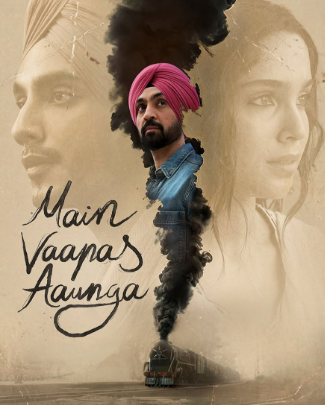
Introduction
Imtiaz Ali has spent his career weaving love stories into fraught, often turbulent backdrops, and Main Vaapas Aaunga (“I Will Return”) might be his most ambitious attempt yet. Reuniting him with Diljit Dosanjh after their acclaimed collaboration on Amar Singh Chamkila, this Partition-era romantic drama pairs Ali’s signature philosophical touch with A.R. Rahman’s music and a career-anchoring performance from Naseeruddin Shah — resulting in a film critics have called uneven but ultimately deeply moving.
Quick Facts
| Category | Details |
|---|---|
| Director | Imtiaz Ali |
| Writers | Imtiaz Ali, Nayanika Mahtani |
| Starring | Naseeruddin Shah, Diljit Dosanjh, Sharvari, Vedang Raina, Anjana Sukhani |
| Music | A.R. Rahman |
| Runtime | 2h 47m |
| Genre | Period Romantic Drama |
| Theatrical Release | June 12, 2026 |
| Streaming Release | August 7, 2026 (Netflix) |
| Language | Hindi |
| Budget | ₹70 crore |
| Worldwide Box Office | ₹98.2 crore (India: ₹65.3 crore net) |
| Netflix Acquisition | Reported ₹30+ crore for digital rights |
Box Office Performance
Main Vaapas Aaunga had a rocky theatrical journey. It opened to a modest, unremarkable response on June 12, with weak initial buzz and minimal advance bookings. But strong word-of-mouth, particularly around Naseeruddin Shah’s performance, helped it build momentum through its second and third weeks — a rare “slow-burn hit” trajectory for a mid-budget Hindi drama in 2026. By its 17th day, it had surpassed the lifetime worldwide collections of Imtiaz Ali’s own Jab We Met (2007), making it one of his most commercially successful films to date. It crossed ₹50 crore net by its fourth weekend, and combined with a strong Netflix streaming deal, the film fully recovered its ₹70 crore budget, ultimately closing out its run as a certified box office success despite the shaky start.
Critical Reception
Reviews have been consistently positive, if not entirely uniform. Rotten Tomatoes critics have praised Naseeruddin Shah’s performance as possibly his meatiest role in a feature film in over a decade, singling out his portrayal of dementia-related memory lapses as especially powerful. Several reviews describe the film as a deeply evocative narrative reflecting a “collective ache for human connection and healing in fractured times.” The most common critique across reviews is pacing — multiple critics noted the film meanders, particularly in its first half, even while agreeing its intentions and emotional core are genuine and well-realized.
Overview
The film opens with Naseeruddin Shah’s character, Keenu (also referred to as Ishar Singh Grewal in some tellings), a 95-year-old man grappling with dementia as he struggles to separate memory from present reality. Haunted by a childhood romance and recollections of love lost during the 1947 Partition of India, Ishar shares his story with his grandson Nirvair, and the past unfolds through parallel timelines — one set in pre-Partition Punjab, the other in a modern-day storyline following a commitment-phobic contemporary romance. Set largely in Punjab and Pakistan’s Sargodha, the film maps its lovers’ anguish onto the historical instability surrounding them, a narrative strategy Ali has returned to across his filmography.
Characters
Keenu / Ishar Singh Grewal (Naseeruddin Shah) — The film’s emotional anchor, a 95-year-old man revisiting his first love and his lost hometown as dementia blurs the line between his memories and the present. Critics have singled out Shah’s performance as one of the film’s strongest elements, arriving just a week after his acclaimed turn as JRD Tata in Made in India: The Titan Story.
Nirvair (Diljit Dosanjh) — Ishar’s grandson, who retraces his grandfather’s past as the story unfolds, marking Dosanjh’s second collaboration with Imtiaz Ali following Amar Singh Chamkila.
Sharvari — Plays a key role in the film’s modern-day timeline, part of the “commitment-phobic present” thread juxtaposed against the pre-Partition romance.
Vedang Raina — Rounds out the modern-day cast, contributing to the parallel present-day love story running alongside Ishar’s historical memories.
Pros & Cons
Pros
- Naseeruddin Shah delivers a genuinely powerful, emotionally resonant performance as the film’s anchor.
- A.R. Rahman’s soulful score adds real weight to the film’s most poignant moments, with singles like “Kya Kamaal Hai” and “Maskara” released ahead of the film.
- Imtiaz Ali’s handling of multiple parallel timelines never loses narrative momentum, according to several reviews.
- The film tackles Partition-era trauma through an empathetic, human-centered lens that critics have called relevant and necessary given current events.
- A genuinely moving, bittersweet finale that reviewers say lingers with viewers well after the credits roll.
Cons
- Several reviews describe the narrative as uneven and a bit overlong at nearly 3 hours.
- One review criticized the film’s opening as a “patchwork of clichéd universalisms,” suggesting the setup leans on familiar genre beats.
- Balancing two love stories across two different eras is a recurring device in Ali’s filmography, which may feel repetitive to viewers already familiar with his other work.
- The film’s “apolitical” handling of the Partition backdrop, while intentional, may feel like a missed opportunity to some viewers wanting deeper political engagement with the era.
Similar Movies
- Amar Singh Chamkila (2024) — Imtiaz Ali and Diljit Dosanjh’s previous collaboration, essential viewing for context on their creative partnership.
- Rockstar (2011) — Another Imtiaz Ali romantic drama blending music, memory, and longing.
- Pinjar (2003) — A Partition-era drama exploring similar themes of displacement and lost love.
- Gadar: Ek Prem Katha (2001) — For another take on love set against the backdrop of India-Pakistan Partition history.
- Jab We Met (2007) — For fans wanting to see Ali’s earlier, more overtly romantic filmmaking style.
Final Verdict
Main Vaapas Aaunga is far from a flawless film — its nearly three-hour runtime and occasionally uneven pacing hold it back from greatness — but it’s a genuinely ambitious, emotionally rich piece of filmmaking anchored by a stunning performance from Naseeruddin Shah and a score from A.R. Rahman that elevates its most tender moments. For fans of Imtiaz Ali’s philosophical, memory-driven romances, this is a worthy, moving addition to his filmography, even if it doesn’t quite reach the heights of his very best work.
Rating: 7/10 — A flawed but genuinely affecting Partition-era romance, worth watching for Naseeruddin Shah’s performance alone.
FAQs
When did Main Vaapas Aaunga release? It released theatrically on June 12, 2026, and began streaming on Netflix on August 7, 2026.
Who directed Main Vaapas Aaunga? Imtiaz Ali directed the film, also co-writing it alongside Nayanika Mahtani.
What is the film about? It follows 95-year-old Ishar Singh Grewal, who shares memories of a lost childhood romance during the 1947 Partition of India with his grandson, while a parallel modern-day love story unfolds alongside his recollections.
Who stars in the film? Naseeruddin Shah, Diljit Dosanjh, Sharvari, and Vedang Raina lead the cast.
Is this Imtiaz Ali and Diljit Dosanjh’s first collaboration? No, it’s their second, following 2024’s acclaimed Amar Singh Chamkila.
Who composed the music? A.R. Rahman composed the score, with lyrics by Irshad Kamil.
How long is Main Vaapas Aaunga? The film runs 2 hours and 47 minutes.
Where can I watch it now? It’s available to stream on Netflix following its theatrical run.