
Introduction
Mahavatar Narsimha is the kind of film Indian cinema rarely attempts: a big-screen, feature-length animated retelling of a Puranic story, aimed at adults and families alike instead of just children. It tells the story of the child devotee Prahlad, his tyrant father Hiranyakashipu, and the arrival of Lord Vishnu as Narasimha, the half-man, half-lion avatar.
It was made on a modest budget (reported between ₹15 and ₹20 crore, depending on the source) and went on to earn an estimated ₹300 to ₹325 crore worldwide. That made it the highest-grossing Indian animated film ever, and one of the biggest Indian hits of 2025 in any category.
It also has an unusual origin story. The film is the first chapter of a planned seven-film Mahavatar universe, built around the avatars of Vishnu, and it was in the making for years before it reached the screen.
In this review we look at the story, the voice cast, the animation, the music and the pacing, and we tell you honestly whether it deserves your time in the theatre or on Netflix.
Quick Facts
| Film | Mahavatar Narsimha |
| Genre | Mythological animated epic |
| Director | Ashwin Kumar (his directorial debut; also co-editor) |
| Writer | Jayapurna Das (Ashwin Kumar also credited) |
| Producers | Shilpaa Dhawan, Kushal Desai, Chaitanya Desai |
| Production | Kleem Productions |
| Presented by | Hombale Films (the studio behind KGF and Kantara) |
| Music | Sam C.S. |
| Runtime | About 131 minutes (theatrical version) |
| Original language | Hindi (also released in Kannada, Tamil, Telugu and Malayalam) |
| Format | 2D and 3D |
| Festival premiere | 55th International Film Festival of India (IFFI), November 25, 2024 |
| Theatrical release | July 25, 2025 (originally planned for April 3, 2025) |
| OTT release | Netflix, September 19, 2025 |
| Reported budget | ₹15 to ₹20 crore |
| Reported worldwide gross | About ₹300 to ₹325 crore (varies by source) |
| Certificate | UA |
| Our rating | 7.5 / 10 |
The Story Behind the Story: A Primer on Prahlad and Narasimha
If you grew up with this tale, skip ahead. If you did not, here is the background that makes the film land harder.
Hiranyaksha and the Varaha avatar. The tale begins with two demon brothers, Hiranyaksha and Hiranyakashipu. Hiranyaksha drags the Earth (Bhudevi) to the bottom of the cosmic ocean, and Vishnu takes the form of Varaha, the boar, to rescue her and defeat him. His brother Hiranyakashipu swears revenge.
The boon. Hiranyakashipu performs severe penance and wins a boon from Brahma that makes him nearly impossible to kill. He cannot die by man or beast, indoors or outdoors, by day or night, on earth or in the sky, or by any weapon. Convinced he is invincible, he declares himself above the gods and demands that everyone worship him alone.
Prahlad’s defiance. His own son Prahlad, a child, refuses to obey. He remains devoted to Vishnu no matter how hard his father tries to break him. In the traditional story, the king tries repeatedly to get rid of the boy, and each attempt fails.
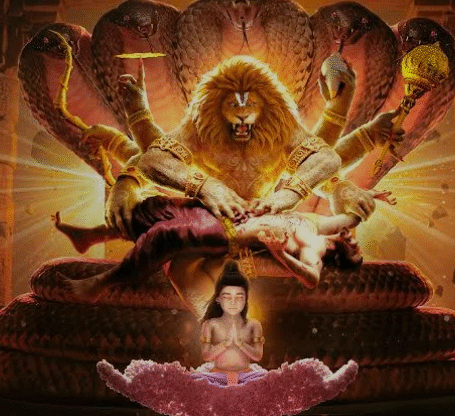
Narasimha. In the climax, Vishnu appears from a pillar as Narasimha, a form that is neither man nor beast, at dusk (neither day nor night), on the threshold of the court (neither inside nor outside), and kills Hiranyakashipu on his lap (neither earth nor sky) with his claws (not a weapon). Every condition of the boon is respected, and the tyrant still falls.
The story is one of the best-known in Hindu tradition, so audiences already know where it is going. That puts the pressure on the filmmaking: the question is not what happens, but how it feels.
Plot Summary (Spoiler-Light)
The film follows the traditional arc but expands the world around it. Based on the film’s credits and publicly available summaries, it covers Varaha’s rescue of the Earth and the death of Hiranyaksha, then moves to Hiranyakashipu’s rise and his boon from Brahma, before turning to Prahlad, a secret devotee of Vishnu who survives his father’s attempts to destroy him. Characters from the wider legend, including Holika and Narad, appear in the story.
The first and middle sections focus on Hiranyakashipu’s pride and the escalating conflict between a father who wants to be worshipped and a son who will not worship him. The action is saved for the end, when Narasimha finally appears.
We will not describe the climax in detail, because it is the film’s strongest sequence and works best when seen fresh. Critics have called it world-class, and even those who found it very violent agreed it delivers.
Voice Cast
The film’s characters are voiced by Hindi voice actors. The cast does not rely on star names, which keeps the focus on the characters.
| Character | Voice actor |
|---|---|
| Hiranyakashipu | Aditya Raj Sharma |
| Prahlad | Haripriya Matta |
| Lord Narasimha | Harjeet Walia |
| Lord Vishnu | Uplaksh Kochhar |
| Hiranyaksha | Sanchit Wartak |
| Holika | Saanwari Yagnik |
| Kayadhu (Prahlad’s mother) | Priyanka Bhandari |
| Narrator | Sanket Jaiswal |
| Lord Brahma | Abhishek Sharma |
| Lord Indra | Dixoan Shah |
| Varun Dev | Shahid Zafar |
| Narad Muni | Harish Moily |
Hiranyakashipu’s voice gives the king the booming arrogance the role needs, and the voice of young Prahlad keeps him gentle without making him weak, which is harder than it sounds.
Behind the Scenes: How the Film Was Made
A long road. The film was announced publicly in mid-2024, but the animation itself reportedly took about four and a half years, with a focus on realistic, detailed visuals. After its premiere at IFFI in November 2024, the theatrical release was first planned for April 2025 and then moved to July 25, 2025.
A personal mission. Director Ashwin Kumar says his interest in this story began in 2007, when he attended a lecture at ISKCON Chowpatty in Mumbai while working in art, VFX and animation. His wife, Shilpaa Dhawan, produced the film and helped raise the money; he has said that his parents and in-laws also backed the project.
Scripture-based research. According to an interview-based piece from ISKCON News, he drew on the Bhagavata Purana, Vishnu Purana, Narasimha Purana and Varaha Purana, among other texts. He also studied traditions linked to Narasimha, such as Holika Dahan, and visited Ahobilam, an important Narasimha pilgrimage site. These are the director’s own statements, but they explain why the film has a reverent tone.
A stated goal. He has said he wanted to challenge the idea that animation is only for children, and the film’s serious tone and violence reflect that.
The studio behind it. Hombale Films, known for KGF and Kantara, presented the film. Its name added weight and reach, and helped it release across five languages.
Animation and Visuals
What works
- Scale and ambition: The demon kingdom, the armour and the costume designs feel grand. The film avoids the dated, cartoonish look that has held back some Indian animation.
- Nature-rich settings: Forests, skies and sacred spaces give the film a warmth and colour that suit the devotional story.
- The big moments: The transformation and battle sequences deliver real goosebumps, especially Narasimha’s arrival.
- A serious tone: The visuals take the myth seriously instead of softening it for children.
What doesn’t
- Uneven polish: Some character movement and facial expressions look stiff, and a few scenes have minor glitches.
- Inconsistent quality: Quieter scenes can look less refined than the large set pieces.
How it compares: Against Hollywood or top Japanese animation, it shows its limits. Against earlier Indian animated films, it is a major step forward in scale and confidence. It proves that an Indian animated film can pull in a big audience, and that is a bigger achievement than any single frame.
Story, Themes and Prahlad’s Faith
Faith that does not shout. The soul of the film is Prahlad. His belief is calm and certain, not stubborn or loud, and the contrast with his furious, powerful father is what gives the film its emotional weight.
Unchecked power. Hiranyakashipu’s boon makes him feel untouchable, and the film shows how pride and power can corrode a person (and a family) from the inside. This is the most timely idea in the story.
Father against son. At its core, the film is a clash between two worldviews inside a single home: force against compassion, fear against love. The director has said he wanted this to reflect generational conflicts today.
A universal message. The film is deeply devotional, but its core message about courage, hope and standing by what you believe has resonated with viewers beyond a single faith.
Music and Sound
Sam C.S. composed the music, which blends bhajans, kirtans and mantra-style chanting with a score for the action. The chanting adds a ritual weight to the fight scenes, and the devotional pieces suit the story’s tone.
The weak spot is that a few musical sequences feel underdeveloped. Some songs are short or arrive without enough build-up, so they do not leave the lasting impression the visuals do. This is a missed opportunity in a story that is so emotionally suited to music.
Pacing and Length
This is the film’s biggest flaw. The first half moves slowly and repeats beats, mainly the different ways Prahlad’s devotion is tested. At least one critic felt it could have been trimmed by about half an hour, and the main action does not begin until close to the final stretch.
The payoff is strong enough that most viewers forgive it, but it is worth going in knowing that this is more devotional drama than non-stop action.
Violence and Suitability for Children
The film is rated UA, and it does not hold back in its darkest moments. Some viewers and reviewers pointed to graphic scenes, including in the final battle. One Indian Express reviewer called the climax “world-class, even if ultra-violent.” Others defended the choices as part of the myth.
Our advice: Fine for most teens and older children. Parents of very young children should preview it or watch alongside them.
The Audience Reaction and Cultural Impact
The film’s reception became a story in itself. In many theatres, viewers chanted along, removed their shoes and treated the screening as a spiritual occasion. Word of mouth drove the box office much more than marketing: the film opened modestly (about ₹2.29 crore on day one, according to reported figures) and then grew sharply, reaching about ₹53 crore gross in its first week.
It performed especially well in Hindi, and its success has opened the door for more big-budget Indian animated films. Reviews were generally positive, with ratings ranging from 2.5 to 4 stars out of 5, and praise went to the direction, visuals and music while the violence and pacing drew criticism.
Box Office and Where to Watch
| Opening day | About ₹2.29 crore |
| First week | About ₹53 crore gross |
| Final worldwide gross | About ₹300 to ₹325 crore (estimates vary) |
| Record | Highest-grossing Indian animated film |
| Streaming | Netflix, since September 19, 2025 |
Check Netflix for the languages available in your region.
What Comes Next: The Mahavatar Cinematic Universe
Mahavatar Narsimha is the first of seven planned animated films from Hombale Films and Kleem Productions, inspired by the avatars of Vishnu. The announced slate is:
| Year | Film |
|---|---|
| 2025 | Mahavatar Narsimha (released) |
| 2027 | Mahavatar Parshuram |
| 2029 | Mahavatar Raghunandan |
| 2031 | Reported as a Dwarkadhish-themed film |
| 2033 | Mahavatar Gokulananda |
| 2035 | Mahavatar Kalki Part 1 |
| 2037 | Mahavatar Kalki Part 2 |
The makers have also spoken of expanding into comics, games and other media. Release dates in a plan this long may change.
Pros and Cons
| Pros | Cons |
|---|---|
| Ambitious scale for Indian animation | Slow first half and repetitive beats |
| Goosebump-worthy transformation and climax | Minor animation glitches and stiff movement |
| Emotionally strong portrayal of Prahlad’s faith | Some musical sequences feel underdeveloped |
| Universal themes of faith, hope and resilience | Graphic violence may be too much for young children |
| Devotional music suits the story | Main action arrives late |
| Serious, respectful tone toward the source | Ending is familiar, so few surprises |
Who Should Watch It?
- Watch it if you enjoy mythological stories, want to see Indian animation at its most ambitious, or want a film the whole family can discuss.
- Skip it if you want fast, constant action or expect Hollywood-level animation polish.
- Good to know: No prior knowledge is needed, but knowing the legend makes the climax land harder.
Our Take
At TheReviewShelf, we came away more moved than we expected. Mahavatar Narsimha explodes onto the screen with a dazzling mix of mythology, emotion and visual spectacle, and it makes you feel both the thrill of a legend and the heartbeat of devotion.
The animation, though not flawless, is ambitious by Indian standards, and it delivers goosebump moments in the transformation and battle sequences, especially Narasimha’s climactic arrival and Prahlad’s unwavering belief.
What sets the film apart is how it weaves ancient lore with timely themes: faith, resilience and the dangers of unchecked power. The soul of the film is Prahlad’s faith, which pulses through every frame and can inspire viewers from all walks of life. It is more than a tale of good versus evil. It is a universal call to surrender to hope and love, and many viewers of different faiths have said they found new strength in their beliefs after watching.
On the other side, some pacing issues, minor animation glitches and underdeveloped music sequences do stand out. But the conviction of the narrative and the sheer power of the divine visuals keep the experience uplifting and immersive. In many theatres the atmosphere became intensely spiritual, with audiences chanting and removing their shoes, which shows that the film’s impact goes beyond entertainment.
Our rating: 7.5 / 10
| Category | Score |
|---|---|
| Story and themes | 8 / 10 |
| Animation | 7 / 10 |
| Voice acting | 7.5 / 10 |
| Music | 6.5 / 10 |
| Pacing | 6 / 10 |
| Emotional impact | 9 / 10 |
Final Verdict
Mahavatar Narsimha is not a perfect film, and its slow first half and uneven animation are real drawbacks. But its heart, its faith-driven emotion and a climax that gives you goosebumps make it one of the most memorable Indian animated films in years. It is also a proof of concept: a big-scale, serious animated epic can work in India. Watch it for Prahlad, stay for Narasimha, and go in with patience for the build-up.
Rating: 7.5 / 10
Have you watched it? Tell us in the comments which scene stayed with you most.
Frequently Asked Questions
1. Is Mahavatar Narsimha worth watching? Yes, if you enjoy mythological storytelling. The climax and the portrayal of Prahlad’s faith are its biggest strengths, though the pacing is uneven.
2. Where can I watch Mahavatar Narsimha online? It has been streaming on Netflix since September 19, 2025.
3. Who directed Mahavatar Narsimha? Ashwin Kumar, in his directorial debut. Hombale Films presents it, and Kleem Productions made it.
4. Who are the voice actors in the film? Among them are Aditya Raj Sharma as Hiranyakashipu, Haripriya Matta as Prahlad, Harjeet Walia as Narasimha and Uplaksh Kochhar as Vishnu.
5. Is the film suitable for children? It is rated UA. Teens and older children should be fine, but some scenes are intense, so preview it for younger kids.
6. How much did Mahavatar Narsimha earn? Estimates range from about ₹300 to ₹325 crore worldwide, making it the highest-grossing Indian animated film.
7. Do I need to know the story of Prahlad beforehand? No. The film explains the background, though knowing the legend makes the ending more meaningful.
8. How long is the film? About 131 minutes in the theatrical version.
9. Is it available in Hindi, Tamil and Telugu? It was released theatrically in Hindi, Kannada, Tamil, Telugu and Malayalam. Check Netflix for what is available in your region.
10. Will there be more Mahavatar films? Yes. It is the first of seven planned films, with Mahavatar Parshuram announced for 2027.