
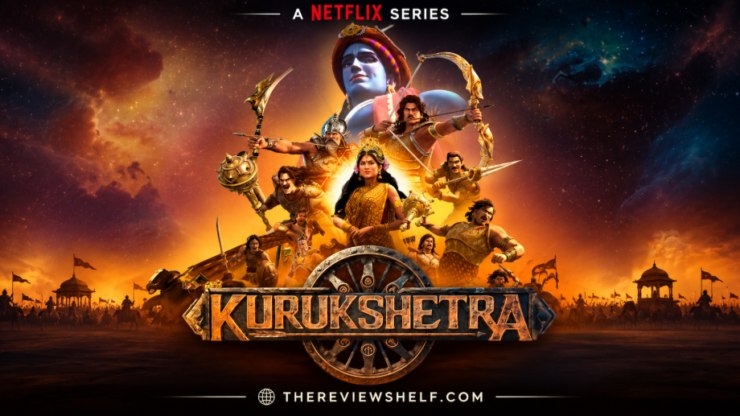
Kurukshetra: The Great War of Mahabharata is Netflix India’s animated retelling of the 18-day epic war, told through 18 episodes that each follow a different warrior. Created by Anu Sikka and directed by Ujaan Ganguly, it is narrated by Gulzar and released in two parts, on October 10 and October 24, 2025. We rate it 3.5 out of 5: a smart structure, a poetic narrator and a strong second half, held back by uneven voice acting and animation.
Quick Facts
| Detail | Info |
|---|---|
| Title | Kurukshetra: The Great War of Mahabharata |
| Platform | Netflix |
| Part 1 | October 10, 2025 (9 episodes) |
| Part 2 | October 24, 2025 (9 episodes) |
| Creator | Anu Sikka |
| Director | Ujaan Ganguly |
| Animation studio | Hitech Animation |
| Narration and lyrics | Gulzar |
| Episodes | 18 in total, about 27 to 31 minutes each |
| Languages | Hindi, with Tamil, Telugu, Kannada, Malayalam and English dubs |
| Genre | Animated mythological war drama |
| Based on | The Mahabharata |
| Our rating | 3.5 / 5 |
Where to Watch
Kurukshetra is streaming on Netflix, with all 18 episodes available. You can switch between Hindi and the five dubbed languages in the audio settings.
Kurukshetra Voice Cast and Narration
| Voice | Role | Role in the story |
|---|---|---|
| Gulzar | Narrator | Frames the war and sets the tone of the series |
| Vinod Sharma | Sanjay | The narrator-observer of the war in the epic |
| Sahil Vaid | Lord Krishna | The guide whose counsel shapes the war |
| Saumya Daan | Arjuna | The Pandava archer at the centre of the conflict |
The series is built around 18 warriors rather than a single hero. Each episode centres on one character, including Abhimanyu in Part 1 and Kripacharya, Kunti, Dushasan, Karna, Duryodhana, Bheem, Ashwatthama and Krishna in Part 2.
Plot (Spoiler-Light)
Kurukshetra retells the war between the Pandavas and the Kauravas as a story of choices and consequences, not a simple fight between good and evil. Each episode takes one warrior and shows the war through their eyes, covering their loyalties, doubts and regrets.
Part 1 sets up the battlefield and its key players across nine chapters. Part 2 turns inward and darker, moving from the fighting to its cost, with a focus on moral ambiguity, loss and what the war leaves behind. The series closes with Krishna.
The tagline captures the idea: “In this war, there are no friends, no enemies, only choices.” We avoid describing the final episodes beyond this, so you can see them for yourself.
Music, Visuals and Production
- Gulzar: His narration and lyrics are the most praised part of the series, and many reviewers named him as its strongest asset.
- Visuals: An anime-inspired style aimed at adults, with large battlefield sequences and quieter character moments.
- Scale: Eighteen episodes across two parts, covering the whole war from many angles.
- Studio: Hitech Animation handled the animation, with Netflix India backing it as its first major animated mythology series.
Part 2 Episodes in Detail
| Episode | Title | Runtime |
|---|---|---|
| 10 | Kripacharya | 31 min |
| 11 | Kunti | 30 min |
| 12 | Dushasan | 30 min |
| 13 | Karn | 30 min |
| 14 | Duryodhan | 29 min |
| 15 | Bheem | 30 min |
| 16 | Ashwatthama | 29 min |
| 17 | Stree Parv | 27 min |
| 18 | Krishna | 29 min |
Part 1 covers Episodes 1 to 9, with one chapter per warrior. Part 2 runs about four and a half hours in total.
Background and Production
- Netflix India’s first. It is described as the platform’s first major foray into animated mythology.
- Creator and director. Anu Sikka created the series, and Ujaan Ganguly directed and wrote it.
- The 18-perspective idea. The creators built the series around telling the 18-day war through 18 different warriors.
- Gulzar’s role. The veteran poet and lyricist lends his voice to the narration and his words to the series.
- Two-part release. Part 1 arrived on October 10, 2025, and Part 2 followed on October 24, in Diwali week.
- Marketing. A trailer was released ahead of launch, and Netflix promoted it as a retelling for a new generation.
- Languages. Besides Hindi, it is available in Tamil, Telugu, Kannada, Malayalam and English.
How It Compares to Earlier Mahabharata Adaptations
The Mahabharata has been adapted many times, most famously as B.R. Chopra’s 1988 television series and the 2013 Star Plus remake, along with several animated films. Those versions told the whole saga across hundreds of episodes. Kurukshetra takes a different path: it focuses only on the war, uses animation instead of live action, and tells it through 18 character-led chapters. That makes it shorter and more personal, though it also assumes you already know the wider story.
How Kurukshetra Was Received
Critics praised the ambition, the structure and Gulzar, while the voice acting was the most common complaint. Reviewers generally rated Part 2 above Part 1.
| Outlet | Part | Takeaway |
|---|---|---|
| Scroll | Part 1 | Saw it as the epic presented as spectacle |
| India Today | Part 1 | Praised Gulzar’s narration but said weak voiceovers marred it |
| Moneycontrol | Part 1 | Said it brings the Mahabharata alive for a new generation |
| Firstpost | Part 1 | Praised its grandeur and imagination |
| Bollywood Shaadis | Part 1 | Said Gulzar’s voice stands out in uneven animation |
| Mint | Part 2 | Praised the final episodes, with Krishna, karma and consequence at the centre |
| Bollywood Shaadis | Part 2 | Called it a masterpiece of animated storytelling |
| Fanzoid | Part 2 | Called it an emotional finale despite uneven pacing |
| M9 News | Part 2 | Called it a worthy finale |
The main arguments among critics.
- For the series: It is a bold, serious attempt at Indian mythology in animation, with a smart structure and a standout narrator.
- Against the series: The supporting voice performances lack impact, and the animation is not consistent across episodes.
- In between: Many reviewers say it is worth watching for its ideas and its second half, even if it is uneven.
Performances
- Gulzar (narrator). The most consistently praised element. His narration gives the series its poetic, reflective tone.
- The supporting voice cast. Critics were less convinced, saying several performances feel flat next to the narration and lack emotional force.
- Sahil Vaid (Krishna) and Saumya Daan (Arjuna). Central to the story’s philosophy, and their scenes carry some of its most important ideas.
- Vinod Sharma (Sanjay). The observer’s voice that connects the war to the audience.
What Works
- The structure. One warrior per episode gives each character real room.
- Gulzar’s narration. Poetic and powerful, and the strongest element of the show.
- A strong second half. Part 2 delivers the emotional payoff.
- A mature tone. It treats the epic seriously, not as a children’s story.
- Karna and Duryodhana. Their episodes turn pride and loyalty into tragedy.
- A bold first step. It shows animated Indian mythology can be ambitious.
What Could Be Better
- Voice acting. Supporting performances often lack impact.
- Animation consistency. Quality varies between sequences, especially in movement and action.
- Uneven episodes. Some chapters feel rich and others thin or rushed.
- Assumed knowledge. Newcomers to the epic may need to look up characters.
- Pacing. Part 2 in particular has stretches of uneven pacing.
Our Review
This review is an editorial summary based on published critic reviews and the episode details.
Kurukshetra is an ambitious series that tries something new with a very old story. Its best idea is the structure. By giving each episode to one warrior, it lets characters who are often reduced to heroes and villains explain themselves. The war stops being a spectacle and becomes a chain of personal decisions, which suits the Mahabharata well.
The series is held together by Gulzar. His narration turns what could have been a battle recap into something closer to poetry, and it gives even the weaker episodes a sense of weight. Almost every critic named him as the show’s greatest strength, and we agree.
Where the series stumbles is in execution. The supporting voice performances often lack the emotional force the material demands, and the animation is striking in some sequences and stiff in others. Because each episode stands on its own, the quality also varies from chapter to chapter.
Part 2 is where the series finds its footing. It shifts from battlefield chaos to loss and aftermath, and episodes like Kunti and Stree Parv are about what the war leaves behind, not the fighting itself. That is where it is most moving.
Our view: this is a flawed but worthwhile retelling, better as an idea than as a finished product, but a strong enough idea to carry it. Start with Part 1 for the setup, and expect the series to grow on you.
The Review in Detail
Concept and structure. The 18-warrior format is the series’ defining choice, and it works. It gives the war emotional variety, since every episode has its own mood and moral question. Karna and Duryodhana benefit most, as their pride and loyalty make their endings feel tragic instead of merely deserved. The weakness is unevenness: with 18 separate chapters, some are bound to be stronger than others.
Gulzar’s narration. This is the soul of the show. His voice gives the war a reflective, poetic frame, and it lifts scenes that would otherwise feel like exposition. It is the first thing most viewers remember.
The voice cast. This is the series’ biggest weakness. Several critics noted that supporting performances feel flat next to the narration, which hurts in a story built on emotional and moral weight. Lines that should land hard often don’t.
Animation and visuals. The anime-influenced style aims at adults, and it works best in quiet, character-focused moments. Large action scenes are more uneven, and some movement feels stiff. It never looks cheap, but it is not consistent across all 18 episodes.
Part 1. It builds the world and the stakes, with the scale and setup that a war story needs. It is the more spectacle-driven half, and it is also where the voice acting and pacing issues are most noticeable.
Part 2. The stronger half by a clear margin. It is darker and more introspective, with episodes built around grief, guilt and consequence. The Kunti, Stree Parv and Krishna episodes are the emotional high points, and the closing chapter ties the series together.
Tone and faithfulness. The series treats the Mahabharata seriously and stays true to its moral questions without turning it into a lecture. It assumes some prior knowledge, which makes it richer for fans of the epic and a little harder for newcomers.
Emotional impact. When the series lands, it lands well, especially in Part 2. But the uneven voice work means some scenes that should move you are merely impressive.
Our Rating
3.5 / 5
| Category | Score |
|---|---|
| Concept and structure | 4.5 / 5 |
| Narration | 5 / 5 |
| Voice acting | 2.5 / 5 |
| Animation and visuals | 3.5 / 5 |
| Story and writing | 3.5 / 5 |
| Pacing | 3 / 5 |
| Emotional impact | 3.5 / 5 |
| Part 1 | 3 / 5 |
| Part 2 | 4 / 5 |
| Rewatch value | 3.5 / 5 |
Should You Watch Kurukshetra?
Watch it if you enjoy mythology with moral complexity, want a mature animated series from India, or are a fan of the Mahabharata.
Skip it or lower expectations if you want nonstop action, or if weak voice acting tends to spoil a show for you.
Best way to watch: In order, with a quick refresher on the main characters if the epic is new to you. If Part 1 feels slow, stay for Part 2.
Final Verdict
Kurukshetra is an ambitious, thoughtful retelling of the Mahabharata war with a brilliant narrator and a strong second half. It is held back by uneven voice acting and animation, but its structure and emotional depth make it a worthwhile watch and a promising first step for Indian animated mythology.
Final rating: 3.5 / 5.
FAQs
What is Kurukshetra about?
It retells the 18-day Mahabharata war through 18 episodes, each following a different warrior.
When was Kurukshetra released?
Part 1 on October 10, 2025 and Part 2 on October 24, 2025.
Where can I watch Kurukshetra?
On Netflix, with all 18 episodes available.
Who created Kurukshetra?
Anu Sikka created it, and Ujaan Ganguly directed it, with animation by Hitech Animation.
Who narrates Kurukshetra?
Gulzar, whose narration is widely praised as the series’ strongest element.
How many episodes does Kurukshetra have?
18 episodes, split into two parts of 9 each.
How long is each episode?
About 27 to 31 minutes.
Which languages is it available in?
Hindi, Tamil, Telugu, Kannada, Malayalam and English.
Is Part 2 better than Part 1?
Most reviewers think so. Part 2 is more emotional and focused.
Who voices Krishna and Arjuna?
Sahil Vaid voices Lord Krishna, and Saumya Daan voices Arjuna.
Who voices Sanjay?
Vinod Sharma.
What are the Part 2 episodes about?
They are titled Kripacharya, Kunti, Dushasan, Karn, Duryodhan, Bheem, Ashwatthama, Stree Parv and Krishna.
Do I need to know the Mahabharata before watching?
Not strictly, but familiarity with the main characters and events helps.
Is Kurukshetra suitable for children?
It is aimed at adults and older teens, given its war themes and serious tone. Check the rating on Netflix before watching with young children.
What did critics say?
Reviewers praised the structure, the visuals and especially Gulzar’s narration, while criticising uneven voice acting and animation.
Is it better than earlier Mahabharata adaptations?
It is different. Instead of telling the whole saga, it focuses on the war through 18 character-led chapters.
Is Kurukshetra worth watching?
Yes, with some caveats. We rate it 3.5/5.