
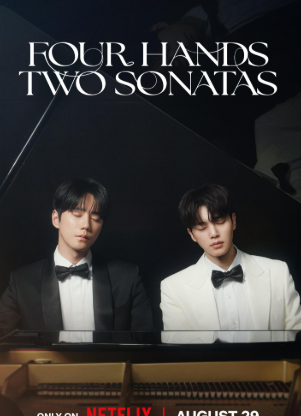
Introduction
Piano dramas are rare in the K-drama space, but Four Hands, Two Sonatas arrived with enough star power to make it one of the genre’s biggest bets in years. Marking Song Kang’s comeback project following his military discharge, this tvN and Netflix original pairs him with Lee Jun-young in a story about musical rivalry, friendship, and first love at an elite arts high school — and it’s already achieved a rare “topicality all-kill,” ranking #1 across both TV and TV-OTT charts in its debut week.
Quick Facts
| Category | Details |
|---|---|
| Korean Title | 포핸즈 (Four Hands) |
| Director | Park Hyun-seok (Song of the Bandits, Knock-Off) |
| Writer | Shin Yi-won |
| Starring | Song Kang, Lee Jun-young, Jang Gyu-ri |
| Also Starring | Kim Joo-hun, Yoon Se-ah, Jung Jin-young, Seo Jae-hee |
| Genre | Youth Drama / Music / Coming-of-Age |
| Episodes | 12 |
| Original Network | tvN |
| International Streaming | Netflix |
| Production | Studio Dragon, Studio N, Namoo Actors |
| Air Schedule | Saturdays & Sundays, 21:10 KST |
| Premiere Date | August 29, 2026 |
| MyDramaList Rating | 8.5/10 (1,940+ users) |
| Content Rating | 15+ |
Overview
Set at Korea Arts High School, the story follows two rival piano prodigies from completely different worlds. Kang Pi-o (Song Kang) comes from a privileged background but carries a heavy burden: raised by a single mother and constantly pushed toward perfection by his strict, demanding grandfather, famous pianist Kang Seung-woon (Jung Jin-young), Pi-o is disciplined, reserved, and difficult to read. Choi Jeong-yo (Lee Jun-young) comes from a far more difficult background and has always felt like he doesn’t measure up — but he’s more playful, expressive, and carries his own quiet trauma. When a scholarship controversy and a bullying incident force the school’s piano teacher, Do Hyun-soo (Kim Joo-hun), to pair the two rivals for a four-hands duet performance, their tense dynamic slowly begins to thaw. Jang Gyu-ri plays Jae-in, a confident third student who adds her own personality and stakes to the central trio. Beneath the coming-of-age music drama, the show also threads in a darker mystery — including hints connecting Pi-o’s mother to the death of Jeong-yo’s mother — that’s driven real fan speculation online.
Highlights
- Song Kang’s comeback project — his first major role since completing his military service, making this one of the most anticipated K-drama returns of the year.
- A rare “topicality all-kill” — in its first week, the show ranked #1 in both TV and TV-OTT categories on Good Data Corporation’s FUNdex chart, with Lee Jun-young topping both Performer categories and Song Kang close behind in second.
- Strong and rapidly growing ratings — the premiere drew a 3.4% nationwide Nielsen Korea rating, nearly doubling to 5.9% by the second episode.
- An accomplished director — Park Hyun-seok, known for Song of the Bandits, brings a proven visual sensibility to the show’s music-driven storytelling.
- A distinctive, underused genre setting — elite classical music education is a much less common K-drama backdrop than typical school or workplace settings, giving the show real visual and thematic novelty.
- Strong critical reception so far, with an impressive 8.5/10 score on MyDramaList from nearly 2,000 ratings shortly after premiere.
Fan Reaction and “Bromance” Framing
When Song Kang and Lee Jun-young’s casting was first reported in September 2025, it immediately went viral — but the network’s choice to describe the show as a coming-of-age “bromance” rather than a romance sparked a genuinely public debate among fans. Some BL (Boys’ Love) genre fans expressed disappointment that the intense rivalry-turned-bond between two male leads wasn’t being marketed as an actual romance, while other viewers have pushed back on that framing entirely, with one fan writing online that people calling the show “too gay” simply “can’t handle their sweet Song Kang looking at a boy.” Whatever the intended framing, the chemistry between the two leads has become the show’s single most talked-about element: after Episode 2, one viral fan reaction joked about Pi-o setting up “102,928 candles one by one” just to help Jeong-yo overcome his stage fright, quipping “he wouldn’t even do this for a girlfriend.”
Beyond the shipping discourse, the show has also drawn real, substantive praise. A MyDramaList review that scored the show 8.3/10 broke it down as: 8.5/10 for acting and cast (“strong performances, particularly from Song Kang and Lee Jun-young”), a striking 9.0/10 for cinematography and audio (“superb classical scoring”), and 7.5/10 for story and pacing, noting a “gripping premise” that still “relies on familiar melodrama.” The same reviewer specifically recommended it to fans of Your Lie in April, Whiplash, and Do You Like Brahms?, writing that the piano performance scenes feel “genuinely thrilling rather than boring” even for viewers who aren’t typically drawn to music dramas.
International Reach
The show’s momentum hasn’t stayed confined to Korea. By its second episode, Four Hands, Two Sonatas was already ranking in the Top 10 in 23 countries and regions internationally via Netflix, on top of its chart-topping domestic performance — a genuinely fast international breakout for a show still in its opening weeks.
Pros & Cons
Pros
- Song Kang and Lee Jun-young’s central dynamic is already a major draw, with both actors topping Korea’s real-time popularity charts in their return to television.
- A fresh genre setting (classical piano performance) distinguishes it from more common K-drama backdrops.
- Strong, rapidly climbing viewership numbers suggest genuine word-of-mouth momentum rather than a front-loaded premiere.
- Backed by prestige production companies (Studio Dragon, Studio N) known for high-quality K-drama output.
- A tight 12-episode format, airing in six weeks with two episodes per week, keeps the story moving without unnecessary padding.
Cons
- Reviewers have noted the show leans on familiar K-drama tropes — authoritarian grandparents, hidden parentage, loan sharks, childhood connections — that occasionally dilute the focus on the music itself.
- Some viewers have pointed out a real casting-age gap: Song Kang (32) and Lee Jun-young (29) are playing 17-year-old students, and even in school uniforms, several reviewers noted they read as visibly older than their characters.
- The early non-linear storytelling, with sudden shifts between dark flash-forwards and present-day academy life, has been flagged as temporarily disrupting the pacing.
- As a newly airing show (still mid-run as of this writing), how the darker mystery elements ultimately resolve remains unknown.
- Music-centered dramas can be a niche draw for viewers not already interested in classical performance as a backdrop, though multiple reviewers note the show wins over even non-music fans.
Similar Shows
- Beethoven Virus — an earlier Korean drama built around classical music and orchestral rivalry, for a tonal predecessor.
- The Sound of Magic (Netflix) — for another Korean drama blending youth drama with a strong musical backdrop.
- Do You Like Brahms? — a K-drama specifically centered on classical music students and their romantic and artistic struggles.
- Nevertheless — for another Song Kang-led youth drama showcasing his range in a very different genre.
- Twinkling Watermelon — for more of a music-driven coming-of-age story with strong ensemble dynamics.
My Review
What strikes me most about Four Hands, Two Sonatas isn’t the premise itself — piano rivalry dramas aren’t new — it’s how much the reviews I’ve read keep circling back to the same specific thing: the music scenes genuinely work as drama, not just decoration. When a critic who explicitly says they’re “not even into music or piano dramas” admits their heart races every time the leads sit down to play, that’s a much stronger signal than generic praise for “great chemistry.” It suggests the direction and sound design are doing real narrative work, not just filling space between plot beats.
The network’s insistence on calling this a “bromance” rather than a romance is the part I find most interesting from a storytelling-strategy standpoint. Whether or not that’s a fully accurate description of where the relationship goes, it’s clearly generating exactly the kind of passionate, divided online discourse that keeps a show trending — the viral “102,928 candles” moment is a perfect example of fans reading real romantic weight into a scene the show is technically framing as platonic devotion. That tension between text and subtext is often where a drama’s most engaged fandom lives, for better or worse.
I do think the criticism about casting age is fair and worth taking seriously if you’re considering watching. Song Kang and Lee Jun-young are both in their late twenties and early thirties playing 17-year-olds, and no amount of school uniform is going to fully sell that gap — it’s a real suspension-of-disbelief ask. But based on what reviewers are saying, the performances are apparently strong enough that most viewers get past it within an episode or two, which tracks with how K-dramas have handled this exact issue plenty of times before.
The bigger question mark for me is the darker mystery thread — the hints connecting Pi-o’s mother to Jeong-yo’s mother’s death. That’s a genuinely different register from a coming-of-age music drama, and the reviews mentioning “non-linear storytelling” and “dark flash-forwards” disrupting pacing suggest the show hasn’t fully worked out how to blend those two tones yet. That’s the piece I’d want resolved well by the finale for this to be a genuinely great drama rather than just a very promising one.
My take: based on everything available so far, this is a show worth starting now rather than waiting for it to finish — the two leads’ chemistry and the strength of the piano sequences alone make it worth the time, even if the mystery subplot is still finding its footing. I’d rather watch a drama take real risks with tone, even imperfectly, than play it completely safe.
Final Verdict
Four Hands, Two Sonatas is off to a genuinely strong start — a rare music-centered K-drama backed by a comeback-hungry Song Kang, a rapidly rising Lee Jun-young, and real chart-topping momentum in its opening weeks. With prestige production behind it and an unusually distinctive setting for the genre, this is shaping up to be one of the standout K-dramas of the back half of 2026.
Rating: 8/10 — A fresh, well-produced youth drama with real star power and early momentum, though its full arc is still unfolding.
FAQs
Is Four Hands, Two Sonatas a BL (Boys’ Love) drama? No, the network officially describes it as a coming-of-age “bromance” and youth music drama rather than a romance, though the intense bond between the two male leads has sparked real fan discourse and shipping regardless of the official framing.
Are the actors playing characters much younger than their real age? Yes — Song Kang is 32 and Lee Jun-young is 29, both playing 17-year-old high school students. Several reviewers have noted this age gap is noticeable on screen, even though the actors’ chemistry and performances have largely won viewers over regardless.
How is the show performing internationally? Very well — by Episode 2, it was already ranking in the Top 10 in 23 countries and regions on Netflix, on top of its #1 domestic chart performance in Korea.
When did Four Hands, Two Sonatas premiere? August 29, 2026, on tvN in Korea, with international streaming via Netflix.
How many episodes does it have? 12 episodes, airing two per week on Saturdays and Sundays.
Who stars in Four Hands, Two Sonatas? Song Kang, Lee Jun-young, and Jang Gyu-ri lead the cast, with Kim Joo-hun, Yoon Se-ah, and Jung Jin-young in supporting roles.
What does the title mean? “Four hands” is a piano term referring to a technique where two people play a single piano together, reflecting the central characters’ intertwined musical and personal journeys.
Is this Song Kang’s comeback drama? Yes, it’s his first major project following his discharge from South Korea’s mandatory military service.
How is the show performing so far? Very well — it achieved a “topicality all-kill,” ranking #1 in both TV and TV-OTT categories in its debut week. Nielsen Korea ratings rose from 3.4% nationwide for the August 29 premiere to 5.9% by the August 30 second episode.
Where can I watch Four Hands, Two Sonatas? It airs on tvN in South Korea and streams internationally on Netflix.
Is Four Hands, Two Sonatas well-reviewed? Early reception is very strong, with an 8.5/10 score on MyDramaList from nearly 2,000 user ratings shortly after its premiere.