
Introduction
Few book series have shaped a generation of readers quite like Harry Potter. J.K. Rowling’s seven-book saga about a boy wizard didn’t just dominate bestseller lists — it got millions of kids (and plenty of adults) genuinely excited about reading again. From a cupboard under the stairs to the final battle at Hogwarts, this is the complete rundown of the series that redefined modern fantasy publishing.
Genre, Format, Reading Level
- Genre: Fantasy / Coming-of-Age / Adventure
- Format: 7-Book Series
- Reading Level: Middle Grade to Young Adult (matures with each book)
Overview
The series follows Harry Potter, an orphaned boy who discovers on his eleventh birthday that he’s a wizard — and a famous one, having survived an attack by the dark wizard Lord Voldemort as an infant. Enrolled at Hogwarts School of Witchcraft and Wizardry, Harry forms lifelong friendships with Ron Weasley and Hermione Granger while slowly uncovering the truth about his parents’ deaths and the growing threat of Voldemort’s return. Across seven books, the story shifts from a whimsical school adventure into a much darker war narrative, following Harry from age eleven to seventeen.
The Books, One by One
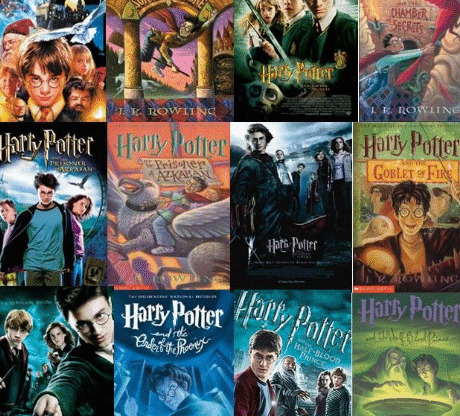
1. Harry Potter and the Philosopher’s/Sorcerer’s Stone (1997) Harry learns he’s a wizard and starts his first year at Hogwarts, where he, Ron, and Hermione uncover a plot to steal the Sorcerer’s Stone — and Harry gets his first real look at Voldemort.
2. Harry Potter and the Chamber of Secrets (1998) A mysterious force is petrifying students at Hogwarts, and Harry must uncover the truth behind the legendary Chamber of Secrets before it claims a life.
3. Harry Potter and the Prisoner of Azkaban (1999) An escaped prisoner, Sirius Black, is hunting Harry — or so it seems. This book digs deeper into Harry’s family history and introduces time-turners, werewolves, and one of the series’ most beloved twists.
4. Harry Potter and the Goblet of Fire (2000) Harry is mysteriously entered into the deadly Triwizard Tournament, and the book ends with Voldemort’s full return — marking the series’ tonal shift into darker territory.
5. Harry Potter and the Order of the Phoenix (2003) Harry battles a hostile Ministry of Magic that refuses to believe Voldemort is back, while forming Dumbledore’s Army to secretly train his fellow students.
6. Harry Potter and the Half-Blood Prince (2005) Harry uncovers Voldemort’s tragic backstory and the secret of the Horcruxes, building toward one of the series’ most devastating losses.
7. Harry Potter and the Deathly Hallows (2007) Harry, Ron, and Hermione abandon school entirely to hunt down and destroy Voldemort’s Horcruxes, leading to the all-out Battle of Hogwarts and the series’ finale.
Highlights
- A fully realized wizarding world — from Diagon Alley to Quidditch to the intricate rules of magic, Rowling built one of the most immersive fictional universes in modern fiction.
- Characters that grow up with the reader — Harry, Ron, and Hermione age and mature across the books, and the writing style matures alongside them.
- Foreshadowing and payoff — small details planted in early books (Books 1–3) pay off dramatically by the finale, rewarding rereads.
- A genuinely satisfying villain arc — Voldemort’s backstory in Half-Blood Prince reframes the entire series in retrospect.
- Real emotional stakes — major character deaths in the back half of the series give the story weight beyond typical children’s fantasy.
Why You Should Read It
- It’s one of the most influential fantasy series of the last century, shaping the modern YA and middle-grade fantasy genre.
- The series works on multiple levels — younger readers can enjoy it as a fun adventure, while older readers pick up on darker themes around prejudice, loss, and power.
- The world-building is dense enough to reward attentive readers, but accessible enough for first-time fantasy readers.
- It’s a genuine “grows with you” series — the tone, complexity, and length increase with each book, mirroring Harry’s own aging.
- Even having seen the films, the books contain significant detail, character depth, and subplots that didn’t make the screen adaptations.
Recommendations — If You Liked Harry Potter, Read These Next
- Percy Jackson and the Olympians by Rick Riordan — a lighter, faster-paced series for younger readers with a similar “ordinary kid discovers a hidden world” setup.
- The Chronicles of Narnia by C.S. Lewis — a classic portal-fantasy series with similar themes of good versus evil.
- A Wizard of Earthsea by Ursula K. Le Guin — a more literary, contemplative take on a young wizard’s coming-of-age.
- The Kingkiller Chronicle by Patrick Rothfuss — for older readers wanting a more mature magic-school-adjacent story.
- His Dark Materials by Philip Pullman — a darker, more philosophically ambitious fantasy trilogy for readers ready to go deeper.
Conclusion
The Harry Potter series remains a genre-defining achievement — not just for its imaginative world, but for how deliberately it grows alongside its characters and readers. Whether you’re revisiting Hogwarts as an adult or picking up the books for the first time, the series still holds up as one of the most complete, emotionally rewarding reading journeys in modern fiction.