
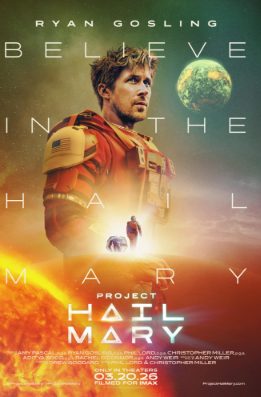
Quick verdict
- Overall rating: 4.5/5
- Genre: Sci-fi, drama, thriller
- Runtime: 156 minutes
- Where to watch: Streaming now (check your regional service)
- Worth watching: Yes
Andy Weir’s beloved 2021 novel finally got its big-screen adaptation this year, and it didn’t just meet expectations — it blew past them. Project Hail Mary concluded its theatrical run with an impressive $681 million worldwide, making it the genre’s biggest success story of 2026 so far, trailing only the Super Mario Galaxy Movie, which crossed the $1 billion mark. After a long theatrical run and a PVOD window, the film has now made its way to streaming.
The Story
The film follows Ryland Grace, a molecular biologist-turned middle school science teacher, who wakes up on a spaceship 11.9 light years from Earth, tasked with finding a solution for why the sun in Earth’s solar system is dying. Struggling with memory issues from the coma used for space travel, Grace has to piece together both how he ended up on the ship and how to save his planet — and not long into his time awake, he runs into another ship and alien life.
The premise sits at the intersection of hard science and emotional storytelling. Much of the tension comes from Grace working through real scientific problems on screen — the kind of methodical, trial-and-error puzzle-solving that made Andy Weir’s earlier novel The Martian so compelling. But where that story was fundamentally about one man’s isolation, this one pivots halfway through into something else entirely once Grace is no longer alone. The alien he encounters is intelligent, communicative, and — against every instinct Grace brings into the encounter — becomes a genuine partner rather than a threat.
At its core, though, this is being described as a story about connection under impossible circumstances — the friendship Grace forms along the way turns out to be just as central as the science. The film reportedly leans into the humor of the source material too, using Grace’s teacher instincts (breaking down enormously complex problems into simple steps) as both a plot device and a recurring source of comic relief.
Production Notes
Bringing an alien co-lead to life without turning the character into either a background presence or an empty CGI spectacle was one of the film’s biggest technical challenges, and much of the post-production work reportedly centered on making that relationship feel emotionally real. The 156-minute runtime gives the science-heavy midsection room to breathe rather than rushing it — a pacing choice several reviewers point to as key to the film earning its emotional payoff later on. The project carried a reported production budget in the $200 million range, reflecting the scale of its space-set visuals and effects work.
Cast and Crew
The film was directed by Phil Lord and Christopher Miller and written by Drew Goddard. It stars Ryan Gosling as Ryland Grace, joined by Sandra Hüller, Ken Leung, James Ortiz, Liz Kingsman, and The Bear breakout Lionel Boyce. Gosling also produced the film alongside Amy Pascal, Lord, Miller, and Andy Weir himself.
Greig Fraser handled cinematography, with a score from Daniel Pemberton.
Reception
The numbers tell part of the story, but critics backed it up too. The film holds an impressive 95% score on Rotten Tomatoes’ Tomatometer across 421 reviews, alongside a 95% audience Popcornmeter score from over 25,000 verified ratings.
Critics have drawn comparisons to classic first-contact and lone-astronaut stories. One review pointed to echoes of Close Encounters of the Third Kind, and even oddball genre entries like Galaxy Quest and Spaceman. The reviewer also noted that the lonely-astronaut archetype is well-worn territory for Gosling, who previously played one in Damien Chazelle’s Neil Armstrong biopic.
Much of the credit for the film’s success has gone to Lord and Miller’s adaptation and direction, the duo behind the Spider-Verse movies — notable given the project had no built-in franchise audience beyond the book’s popularity. Strong word-of-mouth kept audiences coming throughout its run, prompting Amazon MGM to extend the theatrical window to over three months.
Box Office Journey
The film’s box office run started strong, hitting $140.9 million globally in its opening stretch — a notable win, since it marked Amazon MGM’s first commercial theatrical hit as the studio worked to establish itself as a major player in the movie business. From there, it kept climbing all the way to its $681 million final worldwide tally.
Pros and Cons
What you’ll love:
- A genuinely moving alien-friendship arc that avoids feeling gimmicky
- Hard-science problem-solving that stays accessible without dumbing things down
- Gosling anchors the emotional weight without overplaying it
- Visually ambitious space sequences that justify the big screen (or a good TV setup at home)
What could have been better:
- The middle stretch takes its time getting to the emotional payoff, which may test patience for viewers wanting a faster pace
- Some side characters back on Earth get less development than the central relationship deserves
- A couple of science-explainer scenes lean a bit expository
If You Liked This, Watch…
- The Martian (2015) — same author, same problem-solving-under-pressure spirit
- Arrival (2016) — for another thoughtful, communication-driven first-contact story
- Interstellar (2014) — for the blend of hard science and emotional stakes
- Gravity (2013) — for the isolation-in-space tension
- Spaceman (2024) — a smaller-scale companion piece with a similar lone-astronaut-meets-alien setup
Review Summary
- Story: ⭐⭐⭐⭐☆
- Acting: ⭐⭐⭐⭐⭐
- Music: ⭐⭐⭐⭐☆
- Visuals: ⭐⭐⭐⭐⭐
- Rewatch value: ⭐⭐⭐⭐☆
Why You Should Watch It
- A rare word-of-mouth theatrical hit. In an era dominated by franchise IP, this film built its audience the old-fashioned way — through people telling other people to see it. That kind of momentum is hard to fake.
- Critical and audience scores rarely align this closely. A 95% Tomatometer paired with a 95% audience score is unusual — it suggests the film delivers on both technical craft and pure entertainment value.
- Lord and Miller behind the camera. If you loved the emotional depth and visual inventiveness of the Spider-Verse films, this is the same creative team applying those instincts to a grounded, character-driven sci-fi story.
- Gosling in familiar-but-fresh territory. He’s played the isolated-astronaut role before, but critics note this take finds new emotional ground — helped along by an “unexpected friendship” that’s become the film’s emotional anchor.
- A satisfying blend of science and heart. Fans of hard-science storytelling (think The Martian, also from Andy Weir) will find a lot to like, while the friendship at its center gives it broader emotional appeal beyond just genre fans.
- It’s a complete theatrical event, now easily accessible. With its theatrical and PVOD run behind it, you can now catch it from home without needing to track ticket prices or showtimes.
Best for: fans of The Martian, first-contact stories, and character-driven sci-fi; anyone who wants proof that an original (non-franchise) blockbuster can still work.
My Rating: 4.5/5
This is about as close as a big-budget adaptation gets to nailing what made the book special. The science stays smart without ever feeling like homework, Gosling grounds a premise that could’ve easily tipped into melodrama, and the alien partnership genuinely lands emotionally rather than as a gimmick. It loses half a point only because the middle stretch, while purposeful, does ask for patience before the payoff kicks in. Still, it’s easily one of the most satisfying original sci-fi films of the year.
Have you watched Project Hail Mary yet? Let us know in the comments whether it lived up to the book.
FAQ
Is it worth watching? Yes — critic and audience scores both landed at 95%, and the box office numbers back up the word-of-mouth buzz.
Is it family-friendly? It’s rated PG-13, so it’s generally appropriate for older kids and teens, though there are some intense space-peril sequences.
Is there a sequel? No sequel has been announced. The source novel is a standalone story, so a follow-up isn’t guaranteed.
Does it have a post-credit scene? There’s no confirmed post-credit scene reported for this film.
Where can I stream it? It’s available to stream now — availability varies by region and platform, so check your local streaming service.