
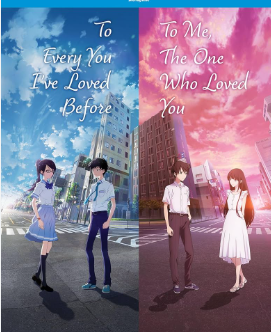
To Every You I’ve Loved Before and To Me, The One Who Loved You are two connected anime movies about parallel worlds, love and fate. They tell separate love stories in different versions of the same world, and together they ask a painful question: if you could live another life, would you end up with the same person?
This guide covers what each film is about, which one to watch first, what makes the pair so memorable, our detailed review, pros and cons, a scorecard, the big fan debate and answers to common questions. It stays spoiler-light, so you can read it before watching.
Quick facts
| To Me, The One Who Loved You | To Every You I’ve Loved Before | |
|---|---|---|
| Japanese title | Kimi wo Aishita Hitori no Boku e | Boku ga Aishita Subete no Kimi e |
| Main character | Koyomi Hidaka | Koyomi Takasaki |
| Love interest | Shiori Sato | Kazune Takigawa |
| Source | Novel by Yomoji Otono | Novel by Yomoji Otono |
| Director | Kenichi Kasai | Jun Matsumoto |
| Screenplay | Riko Sakaguchi | Riko Sakaguchi |
| Studio | TMS Entertainment (6th Studio) | Bakken Record |
| Runtime | 98 minutes | 102 minutes |
| Japan release | October 7, 2022 | October 7, 2022 |
| Streaming | Crunchyroll, from April 20, 2023, in many regions | Crunchyroll, from April 20, 2023, in many regions |
Both films share a Japanese voice cast: Hio Miyazawa as Koyomi, Aju Makita as Shiori and Ai Hashimoto as Kazune, with Mutsumi Tamura voicing young Koyomi. They opened on the same day in Japan and earned roughly the same at the box office, about US$1.6 million each, per Wikipedia. Streaming availability varies by country and changes over time, so check your region before you plan a watch night.
What are these movies about?
Both films are adapted from novels by Yomoji Otono and share one idea: the world has many close parallel versions, and small changes in one life can send it somewhere very different. Each film follows a different person named Koyomi in a different version of that world.
To Me, The One Who Loved You
It follows Koyomi Hidaka, who meets Shiori Sato at his father’s science research center. They fall in love, but their parents also fall in love with each other and plan to get married. To avoid becoming step-siblings, Koyomi and Shiori escape to another parallel world where their parents are not together.
The story focuses on their relationship, their separation and the pain of not being able to end up together. It is the more plot-driven of the two, and it follows the consequences of that escape across years, including Koyomi’s later work with parallel-world science.
The feel: a tense, bittersweet drama about running toward the person you love and what that choice costs.
To Every You I’ve Loved Before
Here, Koyomi Takasaki grows up with his mother after his parents’ divorce. In high school, he meets Kazune Takigawa, who tells him that they are a couple in another parallel world.
The movie focuses on their relationship, how they connect across many worlds, and how some loves are meant to happen again and again, no matter how the world changes. The story follows them through marriage and into old age.
The feel: a gentler, more romantic story about two people finding each other again and again.
The shared theme
Both movies show important choices, different paths a person can take, and how some people are deeply connected, even in different worlds. They are two halves of one story, so each film changes how you feel about the other.
Which should you watch first?
Watch To Me, The One Who Loved You first. You can watch either one first, since both opened on the same day in Japan, but many fans recommend this order. It introduces Shiori’s story and the parallel-worlds idea clearly, so the second film’s connections land harder.
Critics’ notes support it:
- Crunchyroll’s Daryl Harding said To Me, The One Who Loved You could work as a standalone film, according to Wikipedia.
- Crunchyroll’s Alicia Haddick called To Every You I’ve Loved Before “awkward and unfinished” without its companion, per Wikipedia.
- Anime News Network’s reviewer found To Me, The One Who Loved You the stronger film, but felt its ending was underwhelming without the other half.
| Order | Best for |
|---|---|
| To Me, The One Who Loved You, then To Every You I’ve Loved Before | First-time viewers. Starts with the tension, finishes with the warmth. |
| To Every You I’ve Loved Before, then To Me, The One Who Loved You | Viewers who prefer to open with the romance and end on the harder story. |
Whichever you pick, watch both. Each film can be followed alone, but together they tell the full story.
Why are these films unique?
- An emotional love story that is not straightforward. It talks about choices, regrets and hope, and it does not promise a neat answer.
- A parallel-worlds theme with real stakes. The idea makes the story deeper by showing how lives can change from small decisions, and each film shows a different side of the same idea.
- Two films that answer each other. The pair is built so that watching both changes how you read each one. It is closer to two halves of a novel than a sequel.
- Animation and music that carry the emotion. They add to the emotional feel and make important scenes memorable.
- Two directors, two tones. To Me, The One Who Loved You was directed by Kenichi Kasai at TMS Entertainment, and To Every You I’ve Loved Before by Jun Matsumoto at Bakken Record, which gives each film its own look and pacing.
What makes this topic exciting for viewers
- Viewers relate to the characters’ feelings: making tough life choices and dealing with “what if” moments.
- Many are curious about the best watching order, ending explanations and how parallel universes work in the story.
- Fans often debate whether Koyomi is truly meant for Shiori or Kazune, which keeps the conversation going long after the credits.
Our review
These two films work best as one story told from two sides. Each has its own mood, its own Koyomi and its own love, and the real payoff comes from holding them together. This review covers each film, then the pair, without major spoilers.
To Me, The One Who Loved You
The story. This is the sharper, more plot-driven film. The central problem is easy to grasp: two people fall in love, their parents fall in love too, and the only way out is a world where that never happened. The film then asks what it costs to build a life on that escape. Anime News Network’s reviewer called the final two-thirds “far more plot-driven” and found it stronger than its companion.
The romance. The Koyomi and Shiori relationship is the emotional engine. It feels urgent because the obstacle is not a villain but circumstance, and the film is honest about the pain that follows. Readers who like bittersweet romance will find the separation hard to shake.
The ideas. The research-center setting gives the parallel-worlds concept a scientific grounding, and the film uses it to explore regret, responsibility and the limits of escaping a problem.
What holds it back. Voice acting and visuals drew criticism from Crunchyroll’s reviewer, with the lead performance singled out. Anime News Network found the ending “underwhelming” when viewed alone, which is why it is best paired with its companion.
To Every You I’ve Loved Before
The story. A quieter film. Koyomi Takasaki’s life with his mother after his parents’ divorce sets up a lonely teenager who is then told a stranger loves him in another world. The idea is lovely, and it follows the pair across a lifetime, through marriage and into old age.
The romance. Kazune is the heart of this film. The sense that two people keep finding each other across worlds is its main appeal, and it is the film that most directly says some loves are meant to happen again and again.
What holds it back. Anime News Network said Koyomi’s love story carried most of the film “until the final third of it,” and Crunchyroll’s Alicia Haddick found it “awkward and unfinished” without the companion. In other words, it leans on its twin more than the first film does.
The two films together
- Structure. Watching both turns a pair of love stories into a single argument about fate and choice. Details in one film recast scenes in the other.
- Tone. One film is tense and sad, the other tender and wistful. Together they balance each other.
- Pacing. Both run under two hours (98 and 102 minutes), so a double bill fits in one evening.
- Rewatch value. High. Once you know how the worlds connect, early scenes read differently.
Animation and music
The animation and music add to the emotional feel and make the key scenes memorable. The films are not visual spectacles, so their strength is in quiet moments: a look, a pause, a song under a goodbye.
Who we think it is for
Viewers who like emotional, character-driven romance and thoughtful sci-fi ideas. If you want action or a fast plot, look elsewhere.
Pros and cons
| Pros | Cons |
|---|---|
| Emotional love stories with real stakes | Each film leans on the other |
| Clever, human parallel-worlds idea | Endings can feel unresolved on their own |
| Two distinct tones that balance each other | Voice acting and visuals drew criticism |
| Short runtimes, easy double bill | Parallel-world logic needs attention |
| Memorable animation and music | Slow, quiet pacing for some viewers |
| High rewatch value | Mixed reviews on the final act |
Pros in detail
- Emotional love stories. The romances are driven by choices, regret and hope, not by cheap melodrama.
- A human take on parallel worlds. The sci-fi idea is a way to explore love and fate, not a puzzle to solve.
- Two tones. One film is tense and sad, the other tender and wistful, so the pair feels balanced.
- Short and easy to marathon. At 98 and 102 minutes, both fit into a single evening.
- Memorable scenes. Animation and music make key moments stay with you.
- Rewatch value. Knowing how the worlds connect changes how earlier scenes read.
Cons in detail
- They depend on each other. Anime News Network and Crunchyroll reviewers both noted that the endings feel less satisfying when a film is watched alone.
- Uneven execution. Crunchyroll’s reviewer criticized the visuals and voice acting of To Me, The One Who Loved You, particularly the lead performance.
- The final third. Anime News Network felt To Every You I’ve Loved Before lost some of its pull in its last third.
- Concept to follow. The parallel-worlds rules ask for attention, so it is not a casual background watch.
- Quiet pacing. Viewers who want action or a fast plot may drift.
Our rating: 4 out of 5
| Category | To Me, The One Who Loved You | To Every You I’ve Loved Before |
|---|---|---|
| Story and concept | 4.5 / 5 | 4 / 5 |
| Romance and emotion | 4 / 5 | 4.5 / 5 |
| Characters | 4 / 5 | 4 / 5 |
| Animation and music | 3.5 / 5 | 4 / 5 |
| Ending | 3.5 / 5 | 4 / 5 |
| Overall | 4 / 5 | 4 / 5 |
For context, Japanese audience site Filmarks gave the two films almost identical averages on opening day: 3.55 out of 5 for To Me, The One Who Loved You and 3.54 for To Every You I’ve Loved Before, according to Wikipedia. The pair scores 4 out of 5 as a set: gripping, emotional and best watched together.
Fan debates: Shiori or Kazune?
The biggest argument among fans is whether Koyomi is truly meant for Shiori or Kazune. Both films are built to make you feel for both, which is why the debate never settles.
| Case for Shiori | Case for Kazune |
|---|---|
| Her bond with Koyomi is built under pressure, with the whole story pushing against them | Her love feels certain and steady, found again in world after world |
| Their separation is the most painful part of the story | Their story spans a lifetime, so it feels complete |
| The relationship forces both characters to grow | The relationship feels like a warm answer to loneliness |
There is no official winner, and that is the point. These films argue that different worlds can make different loves possible, and that each is real in its own world.
Other questions fans ask
- How do the parallel worlds work? In the films, the world has many close versions, and characters can end up in different ones. Each shift changes who they are with. Watching both films is the best way to see how the idea fits together.
- Do the endings explain everything? Not fully on their own. The two films answer each other, so watch both before judging the ending.
- Is it a love triangle? It is less a classic triangle and more a story about what makes a love “the one,” and whether that answer can change from world to world.
Final verdict
Together, To Me, The One Who Loved You and To Every You I’ve Loved Before make a moving, thoughtful pair about love, choice and fate across parallel worlds. Start with To Me, The One Who Loved You for the tension, finish with To Every You I’ve Loved Before for the warmth, and give yourself time afterward to think about the “what ifs.”
Which film did you love more? Tell us in the comments in detail: were you Team Shiori or Team Kazune, and did you watch in our recommended order?
FAQs
Are the two movies connected? Yes. They are companion films adapted from novels by Yomoji Otono, and they share a world, a voice cast and a central idea.
Which should I watch first? Most fans and several reviewers suggest To Me, The One Who Loved You first, but either order works.
Do I need to watch both? We recommend it. Each can be followed alone, but reviewers found the endings less satisfying without the companion film.
Are they based on a book? Yes. Both are adapted from novels by Yomoji Otono. The Japanese titles are Kimi wo Aishita Hitori no Boku e and Boku ga Aishita Subete no Kimi e.
Who directed them? Kenichi Kasai directed To Me, The One Who Loved You at TMS Entertainment, and Jun Matsumoto directed To Every You I’ve Loved Before at Bakken Record. Riko Sakaguchi wrote both screenplays.
How long are they? 98 minutes for To Me, The One Who Loved You and 102 minutes for To Every You I’ve Loved Before, about 3 hours 20 minutes in total.
When did they release? Both opened in Japan on October 7, 2022, after an early Tokyo screening on September 14, 2022.
Where can I watch them? Crunchyroll began streaming both on April 20, 2023, in many regions including the Americas, Europe, Africa, Oceania and India. Availability changes, so check your country.
Is it a love triangle? Not in the usual sense. It is a story about different worlds and different versions of the same love.
Is it sad? It is bittersweet. To Me, The One Who Loved You is the more painful of the two, and To Every You I’ve Loved Before is warmer, but both have heartbreak.
Is it suitable for teenagers? The leads are high-school aged at points in the story, but the films deal with separation, loss and mature emotions. Check content notes if you are choosing for a younger viewer.